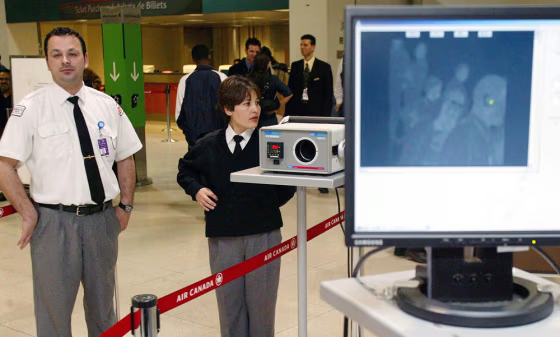
Screening passengers at airports for SARS and influenza will probably not prevent the global spread of the illnesses, health experts said on Friday.
If there is a major outbreak of SARS (Severe Acute Respiratory Syndrome) or influenza, air travel is the most probable route of international infection.
But researchers at Britain’s Health Protection Agency who assessed the benefit of screening if an epidemic occurred said it would not pick up enough cases to be worthwhile.
In the case of SARS, the incubation period is too long for pre-flight screening to offer any guarantee of spotting a carrier, while carriers of influenza are already contagious up to two days before symptoms become apparent.
“The benefits are likely to be pretty small in terms of the number of people you are likely to pick up,” Dr. Richard Pitman, of the HPA which monitors infectious diseases, said in an interview.
The scientists used incubation periods for SARS and influenza to estimate the proportion of air passengers with latent infection who would develop symptoms during a flight to Britain from 100 destinations.
Their findings, which are reported online by the British Medical Journal, are based on the assumption that exit screening would be done in the countries the passengers are arriving from. So people who were obviously ill would have been prevented from travelling.
Low detection rate
SARS is a viral respiratory illness that infected more than 8,000 people worldwide and killed nearly 800 during an outbreak in 2003. It is spread by close person-to-person contact mainly when an infected person coughs or sneezes.
Global health officials believe a flu pandemic which could kill millions of people worldwide is overdue. They are keeping close tabs on the H5N1 strain of bird flu that originated in Asia and which they fear could spark the next pandemic.







 FOR SUBSCRIBERSA harrowing ordeal aboard an Israel-bound plane







FOR SUBSCRIBERSThe debate over AI’s future rages on both coasts

FOR SUBSCRIBERSA harrowing ordeal aboard an Israel-bound plane
FOR SUBSCRIBERSThe debate over AI’s future rages on both coasts
The researchers said SARS' long incubation period of 5-12 days would allow only a small proportion of infected people to be detected. On a 10-hour flight from East Asian countries, a maximum of 21 percent of SARS infected people would be expected to be picked up.
Flu has a much shorter incubation period of 1-2 days than SARS but the number of infected people detected through airport screening would be small, and most would be missed, according to the scientists.
Pitman and his team calculated that if a person was infected with flu two days before their flight they would have a 50 percent chance of developing symptoms during a 10-hour flight.
But as most flights are less than 10 hours, the scientists estimate less than 10 percent of people would develop symptoms during a flight.
Flu sufferers can pass on the illness one or two days before they develop symptoms but scientists are not sure if the same is true for people infected with SARS.
“Screening passengers from the Far East and Australasia therefore derives the most benefit. Even then, the sensitivity for cities in these areas would still be too low,” Pitman, an infectious disease modeler who looks at different scenarios and interventions and potential impacts, said in the report.