Hurricane Rita's wandering aim could determine whether motorists face a small and temporary bump in gasoline prices or must adjust their budgets to absorb a bigger hit over a period of weeks.
Oil-industry experts say Rita's changing projected path and wavering power make it difficult to predict how much damage it will do to refineries on the Gulf Coast in Texas and Louisiana.
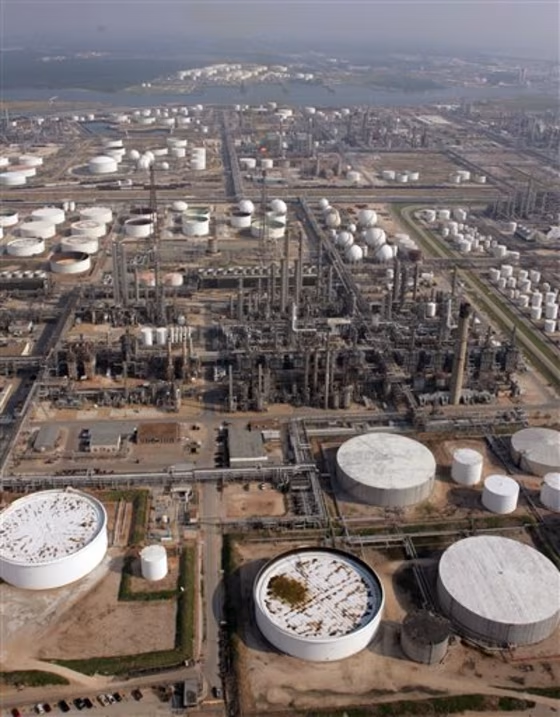
But experts agree that the Houston area — home to 13 percent of the U.S. oil-refining capacity — will not be spared the brunt of the storm.
The storm will reduce the supply of gasoline and other refined products no matter what because just about every major refinery around Houston and Port Arthur, Texas, 100 miles away on the Gulf Coast, shut down ahead of Rita's arrival. Together, the areas represent 20 percent of U.S. capacity.
"Best case, it costs us 2 million barrels a day (of refining production) for about three days," resulting in gas prices briefly rising 5 to 15 cents per gallon, said Fadel Gheit, an energy analyst for Oppenheimer & Co. "But if it hits Houston hard, four or five refineries could be flooded."
Gheit declined to offer a price forecast for the worst-case scenario.
Tom Kloza, an analyst with the Oil Price Information Service of Wall, N.J., said pump prices along the Gulf Coast may soon jump above $3 a gallon.

 FOR SUBSCRIBERSCBP leaders cut out of Trump ad buy decision









FOR SUBSCRIBERSA harrowing ordeal aboard an Israel-bound plane





He said that's because wholesale gasoline prices in the region have climbed by about 75 cents in the past week to $2.50 a gallon before taxes and dealer markup. Motorists in the East and Midwest would see smaller increases, he said.
Energy Secretary Samuel Bodman said even if the Gulf Coast refineries escape serious damage, the public should be ready for interruptions of supplies for two or three weeks.
"We will be dependent on attracting cargoes (of gasoline) from abroad which are already en route," he said.
FOR SUBSCRIBERSCBP leaders cut out of Trump ad buy decision
FOR SUBSCRIBERSA harrowing ordeal aboard an Israel-bound plane
Later, an Energy Department spokesman clarified Bodman's remarks, saying he was referring to local disruptions in Texas and that the administration does not expect a significant effect nationwide.
Oil prices eased at midday Thursday on news that Rita had weakened slightly, to a Category 4 storm. But futures for natural gas, a key fuel for heating homes and producing electricity, continued climbing past $13 per 1,000 cubic feet, nearly twice the level of a year ago.
In the Gulf of Mexico, nearly three-fourths of the manned oil and gas platforms had been evacuated Thursday and oil production was only at about 8 percent of normal _ a loss of 1.38 million barrels of oil a day _ according to the U.S. Minerals Management Service.
Since Katrina evacuations began Aug. 26, the storms have cut 28.5 million barrels of oil production, or 5.2 percent of the Gulf's annual production, the agency said.
At least 11 major refineries along the Texas coast were closed in the process of shutting down Thursday, including the nation's largest, an Exxon Mobil Corp. facility in Baytown, and the third-largest, a BP PLC plant in Texas City. Royal Dutch Shell PLC, Marathon Oil Corp., ConocoPhillips Co. and others also shuttered plants. ConocoPhillips closed its Lake Charles, La., refinery.
The best hope for Houston could be that, unlike New Orleans, it is above sea level and 40 miles inland from the Gulf of Mexico. Still, Houston engineering firm Dodson & Associates concluded in 2001 that a direct hit by a Category 5 hurricane would flood five big oil refineries, 36 chemical plants and an area twice the size of New Orleans.
Chris Johnson, a water engineer who worked on the study, said the government or refineries could have done more to protect themselves.
"We can build a 50-foot concrete wall around a refinery, it just costs a whole lot of money," Johnson said. "That kind of storm is extremely rare. At some point, somebody said, 'This is a risk I can live with.'"