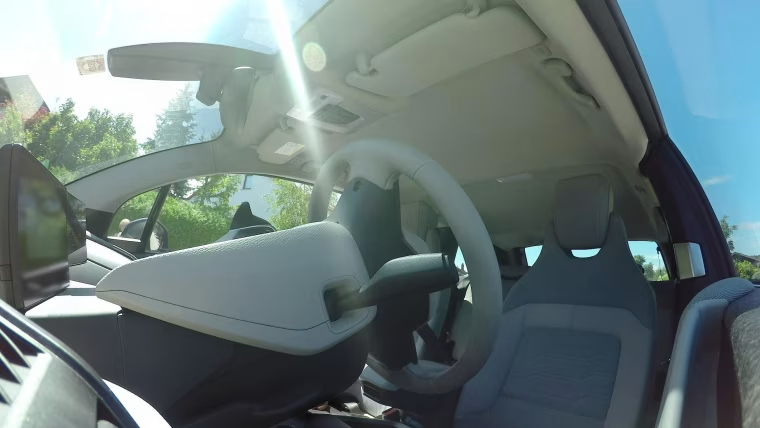
Like it or not, driverless cars and trucks are headed our way. Experts say autonomous vehicles will make getting from point A to point B easier and much safer — in part because they'll save us from our own bad habits.
"Human drivers regularly get behind the wheel impaired by alcohol and drugs and drive when they are fatigued and distracted," Deborah Hersman, CEO of the Itasca, Illinois-based National Safety Council, told NBC News in an email. "It will be easier to design cars that drive themselves than put an end to the persistent behavioral challenges of the last century.”
Hersman is bullish on autonomous vehicles. But she has concerns, including "inconsistent standards, ineffective oversight, lack of consumer education, and overreliance on automation" — all of which, she said, could slow the adoption of a life-saving technology.
Jay A. Winsten, associate dean and the Frank Stanton Director of the Center for Health at Harvard T.H. Chan School of Public Health, has concerns of his own about autonomous vehicles. "The transition to self-driving cars will be a slow and bumpy ride," he told MACH in an email. But he called autonomous vehicle technology "the best way to prevent nearly 40,000 U.S. road deaths each year."
To explore the impact of autonomous technology, the school hosted a panel discussion entitled "Self-Driving Cars: Pros and Cons for the Public's Health." The one-hour event was held May 4 on the school's campus in Boston. You can watch a video of the event above.
Related

The discussion was moderated by David Freeman, editorial director of NBC News MACH. In addition to Hersman and Winsten, panelists included Peter Sweatman, executive advisor for the connected and automated vehicle business unit of CAVita, a consulting firm in Rancho Palos Verdes, California; and John Leonard, vice president for driving research at the Toyota Research Institute in Cambridge, Massachusetts.
The panel was one in a series moderated by Freeman. Others include "Gene Editing: Promises and Challenges" and "Breakthroughs in Disease Treatment: The Landscape Moving Forward."
FOLLOW NBC NEWS MACH ON TWITTER, FACEBOOK, AND INSTAGRAM.