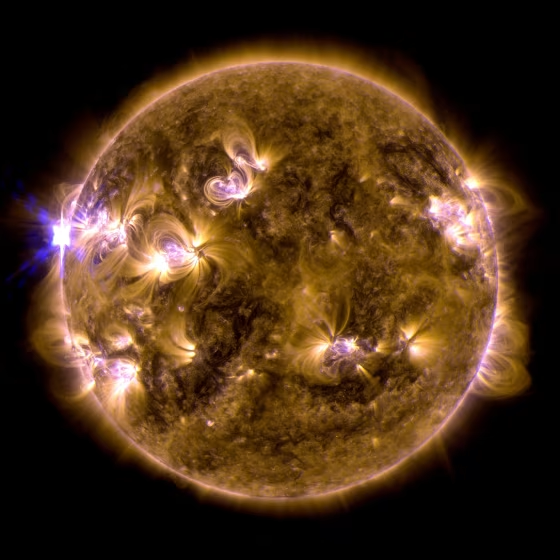
A hyperactive sunspot on the surface of the sun has fired off two of the most powerful solar flares of the year in just 24 hours, and promises to unleash more solar storms over the next several days, space weather experts say.
The active sunspot went into overdrive on Mother's Day when it erupted late Sunday night with an X-class solar flare, the strongest class of solar storm possible. That first eruption registered as an X1.7-class event on the space weather scale, and was followed midday Monday by an even more powerful X2.8 solar flare. That ranks as the third-strongest solar storm in recent years.
You can see a video of the huge solar flares together here as seen by NASA's Solar Dynamics Observatory and other spacecraft. [See more photos of the sun's X-class solar flares]
The Mother's Day solar flare sent a super-hot wave of solar plasma, called a coronal mass ejection, hurtling through space at about 2.6 million mph (4.3 million kilometers per hour). The second flare on Monday sent solar plasma streaking through space at a mind-boggling 4.3 million mph (6.9 million kilometers per hour). The solar eruptions were not aimed at Earth, so should pose no threat to satellites and astronauts in orbit, NASA officials said.
The solar storm could deliver a glancing blow to NASA's infrared-sensitive Spitzer Space Telescope, the Messenger probe orbiting Mercury and the sun-watching Stereo-B spacecraft, according to a NASA update.
"If warranted, operators can put spacecraft into safe mode to protect the instruments from solar material," NASA officials explained. "There is some particle radiation associated with this event, which is what can concern operators of interplanetary spacecraft since the particles can trip computer electronics on board."
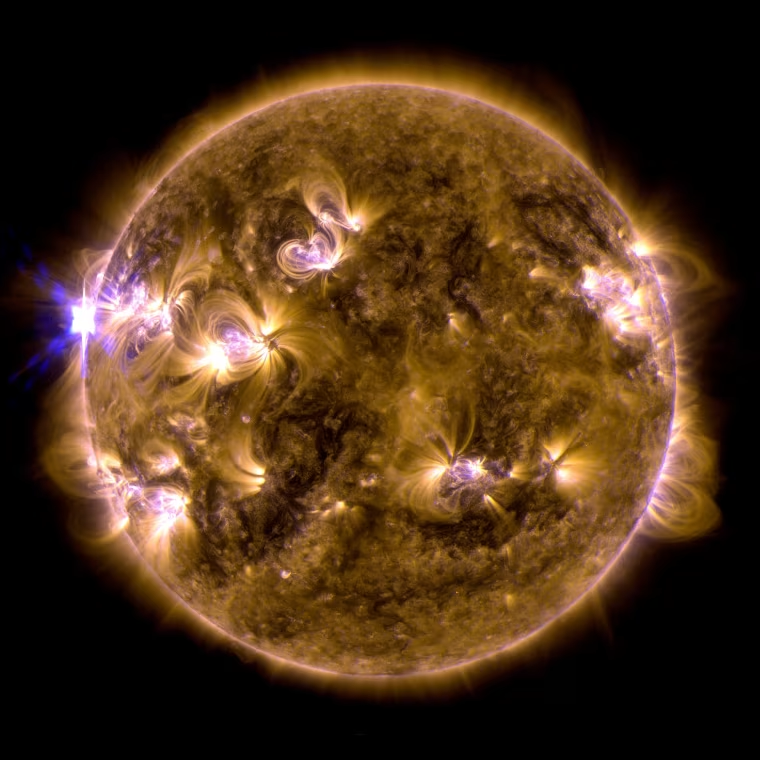
The back-to-back solar storms erupted from an active sunspot region that is just out of sight over the left side of the sun. The region has been active in recent days, spouting off two medium-strength M-class solar flares, but the two X-class solar storms are its most powerful events yet.
The region "will soon rotate into view" as seen from Earth, NASA officials said. When it does, any major solar flares and eruptions could be aimed squarely at Earth.







 FOR SUBSCRIBERSA harrowing ordeal aboard an Israel-bound plane







FOR SUBSCRIBERSThe debate over AI’s future rages on both coasts

FOR SUBSCRIBERSA harrowing ordeal aboard an Israel-bound plane
FOR SUBSCRIBERSThe debate over AI’s future rages on both coasts
"Increased numbers of flares are quite common at the moment because the sun's normal 11-year activity cycle is ramping up toward solar maximum, which is expected in 2013," NASA officials said in the update Monday.
When aimed directly at Earth, X-class solar flares can pose a serious risk to astronauts and satellites in space, and interfere with GPS and communications signals. The strongest solar storms can even affect ground-based power system infrastructure. Moderately strong solar flares can supercharge Earth's northern lights to create spectacular auroral displays.
The sun's current space weather cycle is called Solar Cycle 24 and began in 2008. A fleet of spacecraft, including NASA's powerful Solar Dynamics Observatory, keeps constant watch on the sun for signs of solar flare activity.
Email Tariq Malik at tmalik@space.com or follow him @tariqjmalik and Google+. Follow us @Spacedotcom, Facebook and Google+. Original article on Space.com.
- Major Fireworks On Sun - Two X-Flares On Same Day | Video
- Solar Flares Explained: What You Need to Know
- Solar Max: Amazing Sun Storm Photos of 2013
- Anatomy of Sun Storms & Solar Flares (Infographic)
Copyright 2013 Space.com, a TechMediaNetwork company. All rights reserved. This material may not be published, broadcast, rewritten or redistributed.