WASHINGTON - An alleged al Qaeda-backed plot to derail a U.S. passenger train in Canada sought to exploit the vulnerabilities of railroads that have not gotten much attention from the American public.
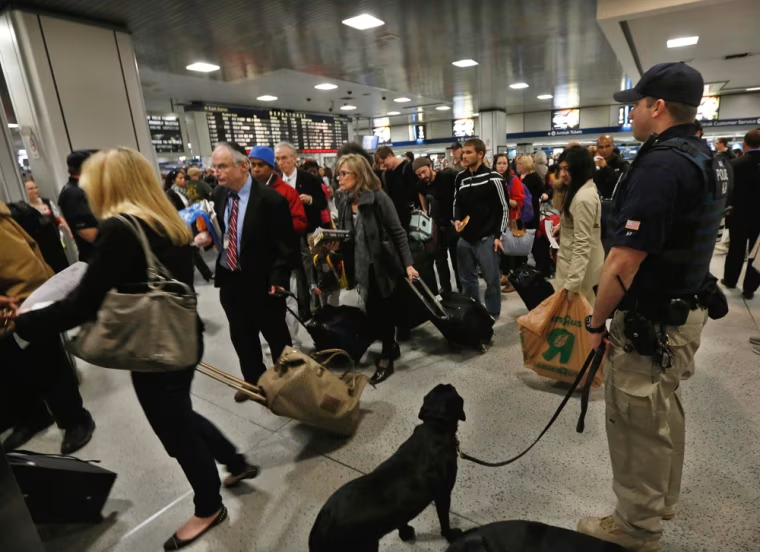
While the United States has sharply tightened security around airlines since the September 11, 2001, attacks, trains are far harder to police, with masses of passengers getting on and off and stops at many stations on a single line. Thousands of miles of track, bridges and tunnels present a major challenge to monitor.
















Even though the United States has largely been immune from attacks, extremists around the world have frequently exploited rail transport's vulnerability, said Brian Michael Jenkins, a security expert with the Mineta Transportation Institute at California's San Jose State University.
"Surface transportation really has become the terrorists' killing fields," he said.
Two suspects were arrested in Canada on Monday charged with conspiring to blow up a trestle on the Canadian side of the border as the Maple Leaf, the daily Amtrak connection between Toronto and New York, passed over it. Amtrak is the U.S. passenger rail service.
The two men charged in the plot made their first court appearances on Tuesday. A lawyer for one said his client would fight the charges vigorously.
Jenkins and Steve Kulm, an Amtrak spokesman, said trains presented a unique security challenge, different from airports with their screening process for passengers.
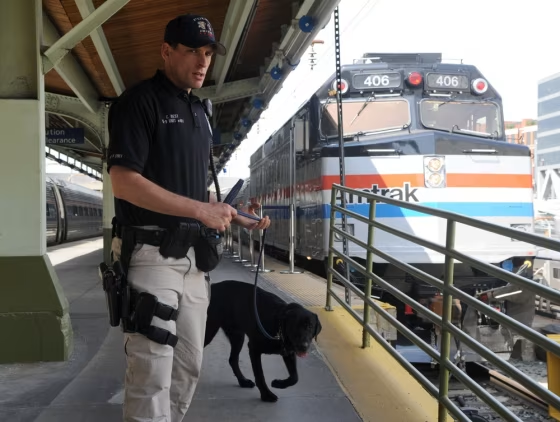
Amtrak coordinates security with local law enforcement, does counterterrorism exercises and patrols its tracks and stations, Kulm said. It also is reconfiguring stations to make them safer from potential attack.
"It's no surprise and no secret that overseas terrorists have targeted rail transportation, and so we have, as I say, many seen and unseen measures that we have put in place and continue to improve upon," Kulm said.
More fatalities in surface attacks
Although popular attention has tended to focus on airliner attacks, far more people have died worldwide from surface transport assaults, Jenkins said.
Since the Sept. 11, 2001, militant attacks on the United States, there have been 75 assaults on airliners, with 157 fatalities, he said.
During the same period, there were 1,800 attacks on surface transport, with nearly 4,000 people killed. Among them were attacks on Madrid in 2004 and on Mumbai in 2006 that each killed about 200 people, and a 2005 London bombing that claimed 52 lives.
In the United States, only one person has died from an extremist rail attack in recent decades, when Amtrak's Sunset Limited was derailed in Arizona in 1995. Responsibility was claimed by a group calling itself Sons of the Gestapo and the saboteurs have not been found.
The United States has more than 200,000 miles of railroad, with about 21,000 miles used by Amtrak. Amtrak carried 31.2 million passengers in the last fiscal year, its ninth record year in the last 10, Kulm said. As a comparison, about 642 million passengers were carried within the U.S. by airlines in 2012, according to the Department of Transportation.
Elliot G. Sander, a former chief executive of the Metropolitan Transportation Authority of New York, which runs two of the biggest U.S. commuter railroads, said public awareness was critical to countering potential attacks.
"One cannot understate the importance of the participation of the public, in terms of eyes and ears," he said.
Far fewer security personnel
The Department of Homeland Security spent $136 million in the 2013 fiscal year on surface transportation security, with 775 personnel. Aviation security received $5.3 billion and has 53,000 personnel.
Special Visible Intermodal Prevention and Response teams carry out random baggage and security checks at train, subway and bus stations as well as at truck weighing stations.
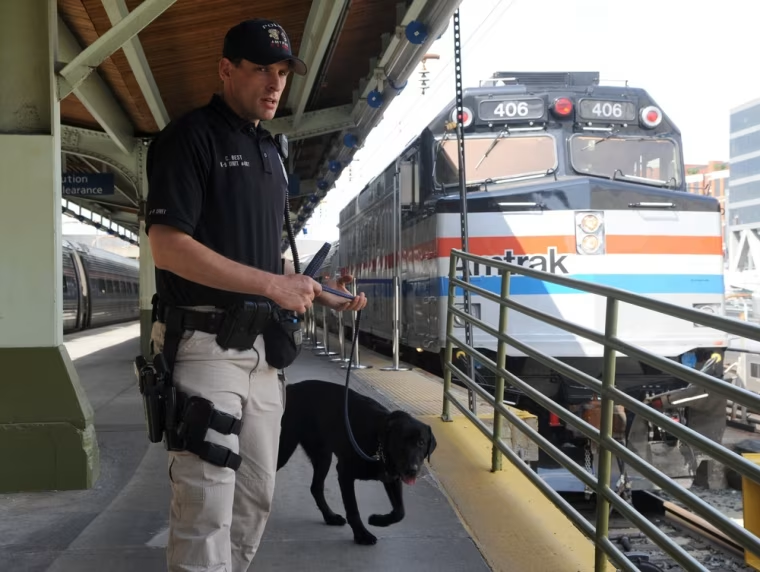
Created after the Madrid railway bombing, the VIPR teams carried out more than 9,300 operations in fiscal 2011, according to the Department of Homeland Security's 2013 budget request.
The Transportation Security Administration was criticized last year by the Government Accountability Office, an investigative arm of Congress, for failing to carry out analysis of railroad security information.
The GAO also criticized the TSA for inconsistent reporting requirements from rail agencies and failure to inspect a rail service the GAO did not name. The TSA concurred with the GAO's recommendations for improvement.
More from Open Channel:
- Warm weather helps drive surge in motorcycle deaths
- Gun groups, defense contractors buck downward trend in lobbying
- Chechnya conflict an incubator for Islamic militants around the world
- On social media, Tsarnaevs mixed religious fervor and youthful whimsy
Follow Open Channel from NBCNews.com on Twitter and Facebook