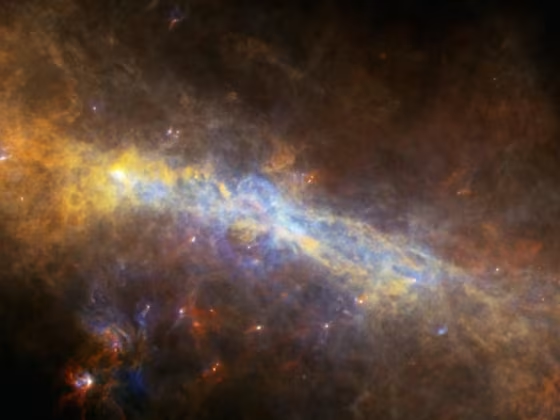
If you look for signs and portents in the skies, you can't do much better than this: The Herschel Space Telescope has provided the best view yet of an infinity sign at the center of our Milky Way galaxy.
"This is what is so exciting about launching a new space telescope like Herschel," Sergio Molinari of the Institute of Space Physics in Rome said in an image advisory issued today. "We have a new and exciting mystery on our hands, right at the center of our own galaxy."
Molinari is the lead author of a research paper on the twisted ring, appearing in a recent issue of Astrophysical Journal Letters. Portions of the ring have been spotted before, but Herschel's image cuts through the dust at the galactic center to reveal the full structure in submillimeter wavelengths. This version of Herschel's view highlights the shape of the ring, which stretches across more than 600 light-years:
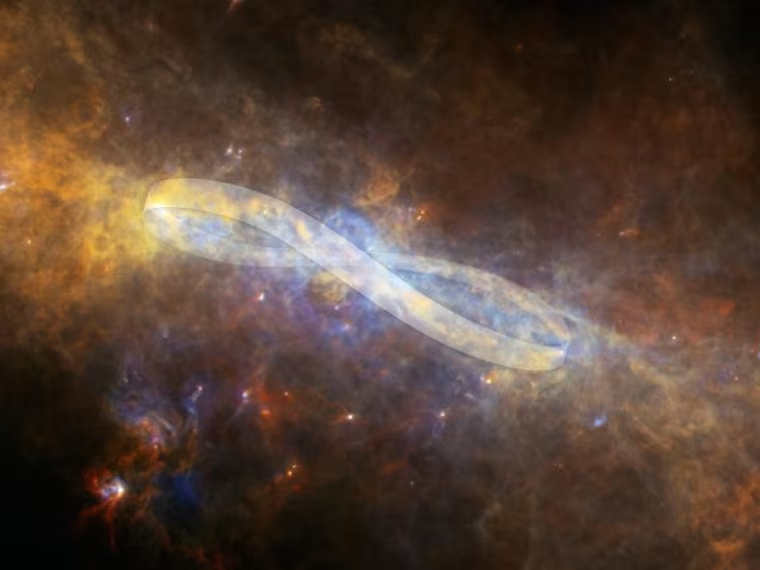
"We have looked at this region at the center of the Milky Way many times before in the infrared," said Alberto Noriega-Crespo of NASA's Infrared Processing and Analysis Center at Caltech, one of the paper's co-authors. "But when we looked at the high-resolution images using Herschel's submillimeter wavelengths, the presence of a ring is quite clear."
Astronomers say the ring is a dense, twisted tube of cold gas mixed with dust — and a cradle for infant stars. They used readings from the ground-based Nobeyama Radio Observatory in Japan to determine how fast gas was circulating around the ring. The radio observations showed that the ring is rolling as a unit, at the same speed as the rest of our galaxy.
The main mystery has to do with how the ring got twisted. The origins of the structure of galactic centers are not well understood, but astronomers suspect that our Milky Way's shape may have been affected by gravitational interactions with nearby galaxies — perhaps including the Andromeda Galaxy, our big celestial neighbor.

 FOR SUBSCRIBERSCBP leaders cut out of Trump ad buy decision









FOR SUBSCRIBERSA harrowing ordeal aboard an Israel-bound plane





FOR SUBSCRIBERSCBP leaders cut out of Trump ad buy decision
FOR SUBSCRIBERSA harrowing ordeal aboard an Israel-bound plane
There's another mystery as well: The center of the twisted ring does not correspond with the actual center of our galaxy, a supermassive black hole known as Sagittarius A*. Noriega-Crespo said it's not clear why the centers don't match up.
"There's still so much about our galaxy to discover," he said.
Amen...
More about Herschel and our bent-up galaxy:
- Greatest hits from Herschel
- Is Milky Way bent like a sombrero? Si!
- Telescope witnesses Milky Way starbirth
- Slideshow: Month in Space Pictures
In addition to Molinari and Noriega-Crespo, authors of "A 100-Parsec Elliptical and Twisted Ring of Cold and Dense Molecular Clouds Revealed by Herschel Around the Galactic Center" include J. Bally, M. Compiegne, J.P. Bernard, D. Paradis, P. Martin, L. Testi, M. Barlow, T. Moore, R. Plume, B. Swinyard, A. Zavagno, L. Calzoletti, A.M. Di Giorgio, D. Elia, F. Faustini, P. Natoli, M. Pestalozzi, S. Pezzuto, F. Piacentini, G. Polenta, D. Polychroni, E. Schisano, A. Traficante, M. Veneziani, C. Battersby, M. Burton, S. Carey, Y. Fukui, J.Z. Li, S.D. Lord, L. Morgan, F. Motte, F. Schuller, G.S. Stringfellow, J.C. Tan, M. A. Thompson, D. Ward-Thompson, G. White and G. Umana.
Connect with the Cosmic Log community by "liking" the log's Facebook page or following @b0yle on Twitter. You can also add me to your Google+ circle, and check out "The Case for Pluto," my book about the controversial dwarf planet and the search for new worlds.