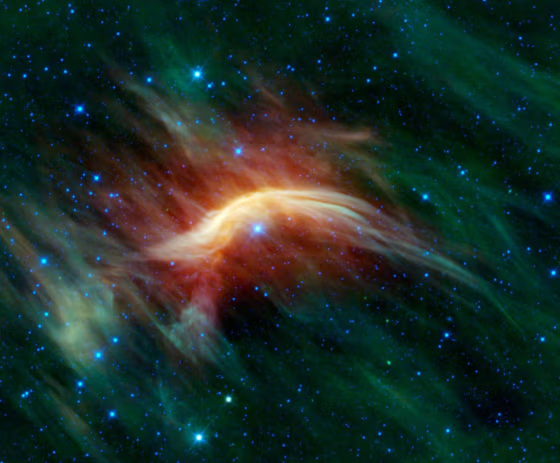
What a difference a wavelength makes! The camera on NASA's Wide-field Infrared Survey Explorer, or WISE, transforms the relatively ho-hum star Zeta Ophiuchi into a stunner, wrapped in a colorful, gauzy shawl of interstellar dust. Astronomers theorize that the blue giant was part of a double-star system that broke up when its partner star went supernova. Now Zeta O. is speeding away through a cloud of dust and gas at a speed of 54,000 mph, and creating the yellowish bow shock you see in this picture. The shock wave is similar to the wave that a boat pushes in front of the bow as it speeds through the water. The feature is completely hidden in visible light, but WISE's infrared camera was able to see it through the obscuring dust. If it weren't for all that dust, Zeta O. would be one of the brightest stars in the sky. Find out more from the WISE website.

 FOR SUBSCRIBERSCBP leaders cut out of Trump ad buy decision









FOR SUBSCRIBERSA harrowing ordeal aboard an Israel-bound plane





FOR SUBSCRIBERSCBP leaders cut out of Trump ad buy decision
FOR SUBSCRIBERSA harrowing ordeal aboard an Israel-bound plane
More infrared wonders:
- NASA shares new views of galaxies
- Andromeda's once and future stars
- Infrared portrait traces life of stars
- Slideshow: Wonders from WISE
Join the Cosmic Log community by clicking the "like" button on our Facebook page or by following msnbc.com science editor Alan Boyle as b0yle on Twitter. To learn more about Alan Boyle's book about Pluto and the search for planets, check out the website for "The Case for Pluto."