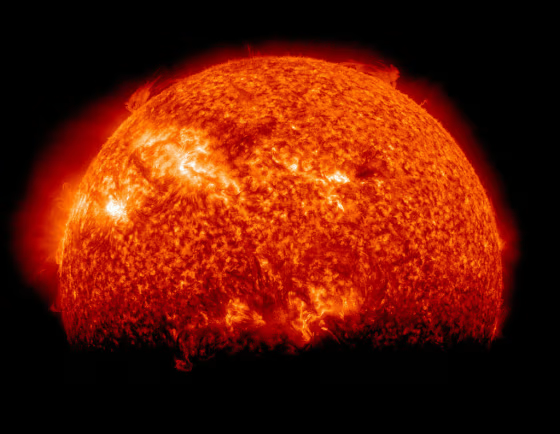
NASA's Solar Dynamics Observatory stares at the sun 24/7, but twice a year, Earth gets slightly in the way for up to 72 minutes a day. That creates an "eclipse" that blocks part of the sun's disk. The spring eclipse season is now under way, as you can see in this picture captured on Tuesday. Your typical partial solar eclipse involves the moon's sharply defined disk passing in front of the sun, but during the Solar Dynamics Observatory's eclipses, Earth's atmosphere creates a fuzzy line between the sun and the darkness. Some of the sun's brighter features manage to shine through the murk.
















Check out NASA's Eclipse website for upcoming opportunities to see eclipses from Earth, including a partial solar eclipse on June 1 and total lunar eclipses on June 15 and Dec. 10.
More out-of-the-ordinary eclipses:
- European probe tracks solar eclipse from outer space
- Eclipse seen by moon probe as Earth blocks the sun
- Sun gets double-crossed by moon and space station
- Watch a partial eclipse and a sunset on Mars
Join the Cosmic Log community by clicking the "like" button on our Facebook page or by following msnbc.com science editor Alan Boyle as b0yle on Twitter. To learn more about my book on Pluto and the search for planets, check out the website for "The Case for Pluto."