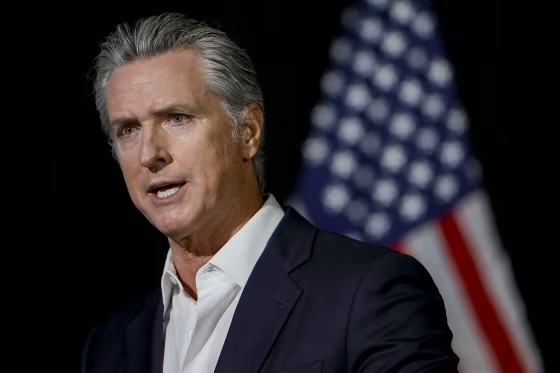
California Gov. Gavin Newsom signed a bill imposing criminal and civil penalties on content creators who fail to disclose paid political advertisements, a measure aimed at bringing greater transparency to the growing use of influencer marketing in politics.
The bill, AB1130, was signed into law Saturday as part of a series of new measures that Newsom’s office said are aimed to “protect elections in California from interference and political meddling.”
Though existing laws required someone to disclose whether they were being paid to post, there was no liability provision that officials could use to enforce the rule. Now, authorities will be allowed to impose penalties under the Political Reform Act of 1974 that can include a misdemeanor charge, according to the law’s text.
Influencers are playing a growing role in political campaigns, as candidates and political groups seek to reach people who increasingly turn to social media for news and information. Some creators are paid by campaigns or outside groups to produce political content, while others post about candidates and issues without compensation.
Assembly member Marc Berman, who proposed the legislation, said the growing influencer industry has “changed the way candidates communicate with voters.”
“As more candidates pay influencers to post content supporting their campaigns, it is imperative that voters have the right to know whether or not that content is organic and authentic or paid political messaging,” Berman said in a statement last month, as the bill was headed to the governor’s desk.
The issue came to the forefront earlier this year during billionaire climate activist Tom Steyer’s more than $200 million campaign for California governor, which he lost.
Steyer’s campaign paid social media influencers to post favorable content about him, but many of the posts did not disclose that the creators had been paid, according to a May report by the Los Angeles Times.
The undisclosed posts prompted a complaint to California’s Fair Political Practices Commission alleging that the campaign had violated the state’s disclosure requirements for paid political content.







 FOR SUBSCRIBERSA harrowing ordeal aboard an Israel-bound plane







FOR SUBSCRIBERSThe debate over AI’s future rages on both coasts

FOR SUBSCRIBERSA harrowing ordeal aboard an Israel-bound plane
FOR SUBSCRIBERSThe debate over AI’s future rages on both coasts
A campaign spokesperson told the Los Angeles Times that all the rules were followed in hiring content creators, describing the complaint as “baseless.” The case involving the complaint remains open, according to the commission’s website.
Researchers at the Information Integrity Institute at the University of Tennessee’s College of Communication and Information published a report last month in which they examined what transparency measures social media users in the U.S. want from paid political influencers.
Their study, in which they surveyed about 1,000 U.S. social media users through the platform Prolific, found that “participants who placed a greater value on authenticity were also more likely to support disclosure when political content was paid for.”
“One of the more real problems is not just you see something that’s completely false or you see something that’s completely true, but you see inauthentic or misleading propagandist-type opinions pushing people’s perspectives in different directions,” associate professor Benjamin Horne said in a blog post about the findings.
The institute’s director, Catherine Luther, added that she believes “any movement towards transparency in online information is a good thing. I think it can only be beneficial for democratic societies.”
