Federal safety investigators began hearings Tuesday to examine why the engine flew off a UPS cargo plane last year, causing a crash that killed 15 people, and why Boeing didn’t address the underlying flaw sooner.
The engine separated from the MD-11’s wing as it accelerated down the runway at Louisville’s Muhammad Ali International Airport in November, killing three pilots on the plane and 12 more people on the ground.
The National Transportation Safety Board’s hearings Tuesday and Wednesday will focus on why it happened. The agency’s final report most likely won’t be ready until more than a year after the crash, because the NTSB will look at everything that might have contributed to it.
Here’s what you should know:
What happened in the crash
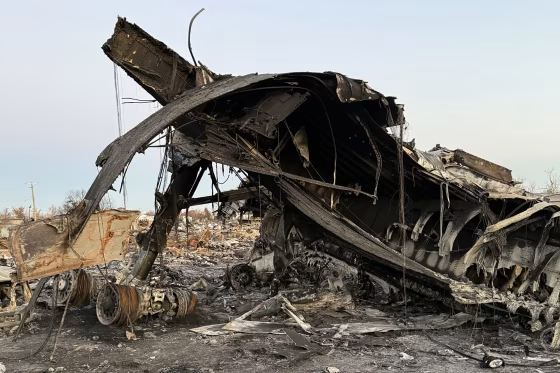
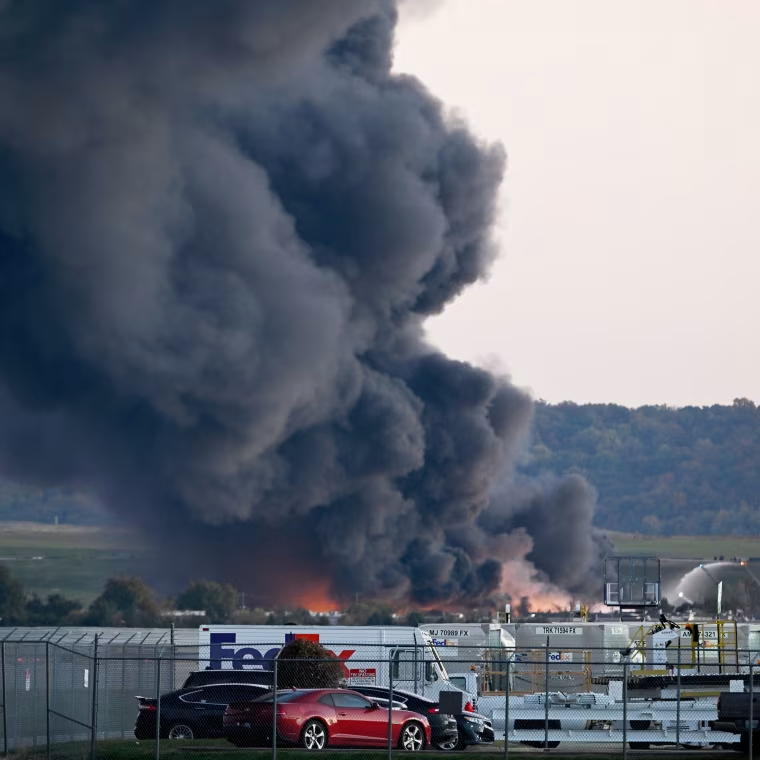
The UPS plane, which was headed for Hawaii loaded with packages and fuel, had barely left the ground and cleared the airport fence when it crashed into several Louisville businesses and created a massive fireball.
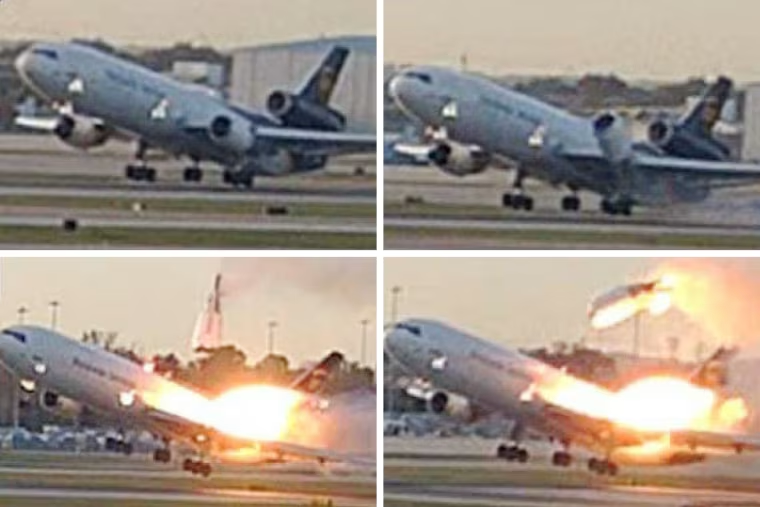
Dramatic photos the NTSB released show the engine detaching and flying up and over the wing as flames erupt on it. The final images show the plane ablaze as it gets airborne, leaving behind trails of smoke.
The crash destroyed two properties, including an auto parts store where four employees and eight customers were killed.
Sean Garber, who owns the auto parts store, Grade A Auto Parts and Scrap Metal Recycling, said he and the families of the people who died have “no closure.”
“I’m still living, and I’m still here able to fight for the people who aren’t able to fight, and those are the people who are so much more impacted,” he said in an interview Tuesday. “But for me personally, I’ve lost an age of innocence. The world just looks different, and I just can’t get that back.”
Garber sued UPS this month, seeking financial compensation.
Michelle Polk, a UPS spokesperson, said in a statement: “The NTSB has not determined a cause for the accident. Our focus remains on supporting the investigation and honoring those affected by this tragedy.”
The crash was reminiscent of a 1979 crash in Chicago involving a DC-10, which was the predecessor of the trimotor jet that crashed in Louisville. The left engine also fell off in that crash, which killed 273 people.
The previous crash led to the worldwide grounding of 274 DC-10s. The airliner returned to the skies because the NTSB determined that maintenance workers damaged the plane that crashed by improperly using a forklift to reattach the engine. That meant the crash wasn’t caused by a fatal design flaw, even though there had already been a number of accidents involving DC-10s.
But even at that point, the plane’s manufacturer, McDonnell Douglas, raised concerns about the spherical bearing that helps hold the engines to the wings. McDonnell Douglas later merged with Boeing.







 FOR SUBSCRIBERSA harrowing ordeal aboard an Israel-bound plane






FOR SUBSCRIBERSThe debate over AI’s future rages on both coasts

FOR SUBSCRIBERSA harrowing ordeal aboard an Israel-bound plane
FOR SUBSCRIBERSThe debate over AI’s future rages on both coasts
Past problems with these planes
The NTSB said shortly after the Louisville crash that investigators had found cracks in some of the parts that held the engine to the wing. The cracks hadn’t been caught in regular maintenance on the plane, which raised questions about the adequacy of the maintenance schedule. The last time the key engine mount parts were examined closely was in October 2021, and the plane wasn’t due for another detailed inspection for roughly 7,000 more takeoffs and landings.
“It was just a ticking time bomb by a company that was more concerned about delivering [than] their employees and the safety of the community around them,” Garber said.
Boeing had documented in 2011 that there were four previous failures of a part that helps secure the MD-11’s engines to the wings on three different planes, but at that point the plane manufacturer “determined it would not result in a safety of flight condition.”
The service bulletin Boeing issued didn’t require plane owners to make repairs as a Federal Aviation Administration airworthiness directive would, and the FAA didn’t issue such a directive. At that point, Boeing simply recommended replacing the bearings with a redesigned part that was less likely to fail.
MD-11 planes flying again
Some MD-11s, workhorses of the cargo fleet, are back in the air after the FAA approved Boeing’s plan to replace the spherical bearing on each aircraft and increase inspections.
FedEx resumed using the planes to deliver packages on May 10, but UPS has said it plans to retire its fleet of MD-11s. Western Global also uses MD-11s but hasn’t said what it plans to do with them.
Some experts speculated after the crash that the MD-11s might never fly again if the repair proved to be more expensive than it was worth in those older planes. But Boeing found a way to address the safety concerns by simply replacing the bearing and stepping up inspections.