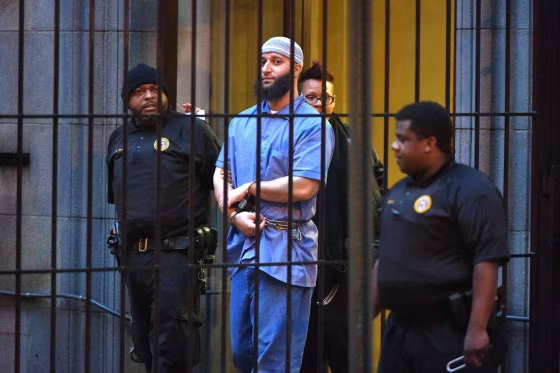
BALTIMORE — A Baltimore judge has ordered new testing for evidence in the case of a Maryland man whose murder conviction was chronicled in the podcast “Serial.”
Baltimore Circuit Court Judge Melissa Phinn signed an order Monday mandating that Baltimore police send evidence in the case against Adnan Syed within 15 days to a California crime lab, news outlets reported.
Last week, prosecutors and Syed’s defense both signed a motion seeking a retest of some items collected as evidence in the 1999 killing of 17-year-old Hae Min Lee using DNA technology that was not available for Syed’s trials.

 FOR SUBSCRIBERSCBP leaders cut out of Trump ad buy decision









FOR SUBSCRIBERSA harrowing ordeal aboard an Israel-bound plane





FOR SUBSCRIBERSCBP leaders cut out of Trump ad buy decision
FOR SUBSCRIBERSA harrowing ordeal aboard an Israel-bound plane
Syed is serving a life sentence after he was convicted in 2000 of strangling Lee and burying her body in a Baltimore park. Syed and Lee were high school classmates who had dated.
In its debut 2014 season, the “Serial” podcast shined a spotlight on the case that led to renewed court proceedings.
Authorities have maintained Lee struggled in a car with Syed before her death. In the latest motion, Syed’s attorney argued that in such circumstances, a killer would have to be in close proximity to the victim. The motion requested testing the evidence for the presence of DNA.

Syed’s defense approached the state’s attorney’s office’s sentencing review unit about Syed’s case, the state’s attorney’s office said in a statement. As the case was reviewed for a possible resentencing, it became clear that it would be appropriate to pursue additional forensic testing, which wasn’t available during the original investigation or trial, prosecutors said. The Juvenile Restoration Act, which passed last year, allows those convicted as juveniles to request a sentence modification after serving at least 20 years in prison.
The Office of the Attorney General oversaw the DNA analysis of evidence in Syed’s case in 2018 and none of the samples tested positive of Syed. His defense argued that was proof he didn’t kill Lee, but prosecutors disagreed. Items being tested under this order weren’t tested during the attorney general’s review.