News analysis
















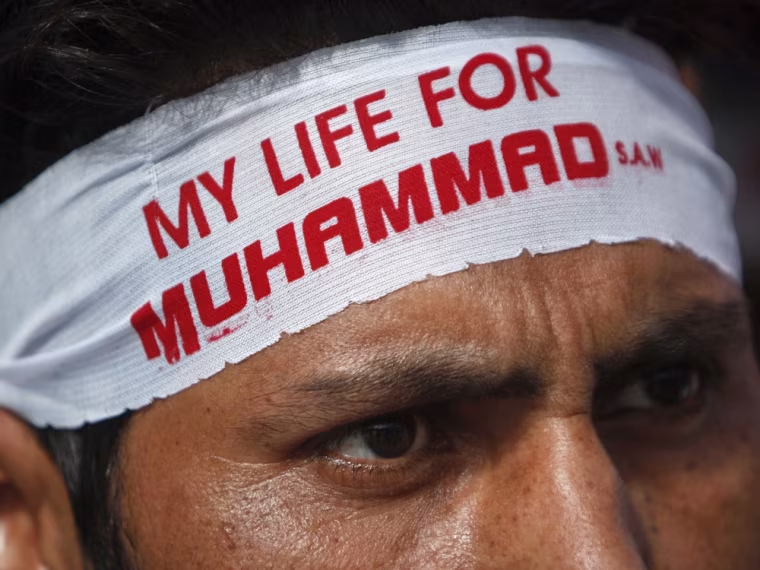
Updated at 7:53 a.m. ET: CAIRO — It's been just over a week since hundreds, perhaps a thousand, angry and offended Egyptians gathered outside the U.S. Embassy's gates in Cairo. They carried Islamist banners and chanted, "The only God is God and Muhammad is his Prophet."
At one point perhaps two dozen of the more brazen protesters scaled the wall and breached the embassy grounds. They lowered and destroyed the U.S. flag and raised a black, Islamic flag in its place. They fled when security guards (not the Egyptian police) fired warning shots over their heads.
This amounted to little violence, but the act itself was the psychological equivalent of taking a beachhead. Within hours reports emerged that a similarly sized group had stormed the U.S. Consulate in Benghazi, Libya. Some were calling it a copycat protest, but it was much more perilous: Four Americans were killed in the melee, including the U.S. ambassador.
Within 48 hours the world would witness angry protests unfolding at U.S. embassies, businesses and symbols of power in more than 20 countries.
This paroxysm of protest — and violence — had begun in Cairo. But what, really, began there?
Much of the mainstream media has played it as a spontaneous reaction to a disgusting film clip which denigrated Muslims and happened to be made and promoted in the USA.
But New York Times editorialist Ross Douthat argued it had nothing to do with a "genuine popular backlash," but everything to do with old-style power politics. For Jim Clifton, chairman of the pollster Gallup, it wasn't about religion or politics, but rather the desperate expression of young Arab males, deeply humiliated because they couldn't find jobs.
'Political manipulation'
Egyptian analysts seem to be more in agreement: Many protesters outside the U.S. Embassy were genuinely offended by the film. But the real driving force behind the protest — in Cairo and Benghazi — were radical Islamist groups who know how to exploit rage for political gain.
"There are still a lot of questions that need to be answered," said Mona Eltahawy, an Egyptian journalist. "For instance, why after two months of being on YouTube did this film suddenly explode on the anniversary of 9/11? That is political manipulation and manufactured outrage that the right wing is all too happy to use.''
Egypt issues arrest warrants for Terry Jones, Coptic Christians over anti-Islam video
By "right-wing" Eltahawy means ultra conservatives – often called Salafists – who practice a strict, puritanical form of Islam and make up the fastest-growing Islamic political and social movement in the world. On the night of the Cairo embassy attacks, the Salafists saw an opportunity to flex their muscles.
"A lot of people went to the U.S. Embassy not just because of the film, and after the film died down, it wasn't about the film anymore," Eltahawy explained. "They went because of anti-U.S. sentiment, because they know in this region how easy it is to fan the flames of anger."
Dr. Gamal Abdel Gawad, a highly respected Egyptian political analyst, agrees.
"I don't think it was spontaneous," he told NBC News. "People were gathering in one place at a certain time of day, so there was some mobilization behind it.''
Actress sues, says she was fooled into appearing in anti-Muslim movie
And it's clear to Gawad who did the mobilizing. "Radical Salafist groups orchestrated it to express their views and embarrass the [more moderate] Muslim Brotherhood because of competition between Islamic groups."
Post Arab-Spring power play
What's enfolding in Egypt – and to a large extent in Libya — is not just a series of isolated power plays. In both countries the leaders who emerged from the Arab Spring are struggling to eke out a political center in order to govern their new democracies, while under extreme pressure from more radical Islamist — sometimes jihadist — forces. Everything is still at stake.
This has led some Egyptians — like Eltahawy — to worry that their 18-month-old revolution will be hijacked by the extremists.
"I'm hoping that this right-wing drive of the past days is the dying pangs of a group that understands that the revolution was started by us, the majority, and we remain very much the majority."
Gawad is more sanguine about the future. "The revolution is over. The president is in power, and Egyptian political parties are busy preparing for elections and campaigns. The radical groups can't get significant numbers elected," he said. Still, as dramatic scenes over the past week have shown, those groups — often armed — can wreak havoc.
Egyptian President Mohammed Morsi seemed to give ground to the Salafists, even leaving the country at the height of a standoff between stone-throwing protesters and riot police for diplomatic meetings abroad.
Finally, last Saturday, he gave the order to clear out the protesters and appeared on TV calling on Muslims to protect foreign citizens and property. Some called it a turning point.
Now that a Paris-based satirical magazine has published cartoons of a naked Prophet Muhammad, will Egyptians respond with silent indignation, peaceful marches or be the first to storm their French Embassy?
Jim Maceda is an NBC News foreign correspondent based in London and currently on assignment in Cairo. He has covered the Middle East since the 1970s.
More world stories from NBC News:
- Arctic sea ice reaches new low
- Ultra-Orthodox Jews confront child sex abuse
- State Department: No secret plan to invade Canada
- Russia tells US: We don't want your aid money
- US Muslims denounce both violence and anti-Islam film
- Protesters: 'The Diaoyu islands belong to China!'
- Stay informed: Sign up for our newsletter