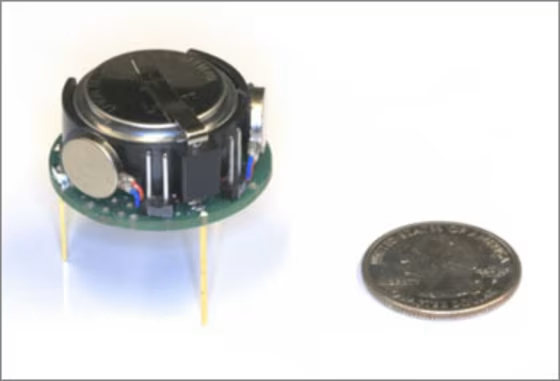
Swarms of robots modeled on the behavior of social insects such as ants are set to invade the research and education marketplace, the university engineers who designed the technology announced Thursday.
The deal between Harvard University and K-Team Corporation, a Swiss manufacturer of mobile robots, will allow educators and researchers to develop and test sophisticated algorithms that control thousands of robots in a physically-grounded setting.
The relatively simple algorithms currently developed in research labs are mostly validated by computer simulations and a few dozen robots at a time due to the limitations of time and cost, the Wyss Institute for Biologically Inspired Engineering at Harvard noted in a news release.

 FOR SUBSCRIBERSCBP leaders cut out of Trump ad buy decision









FOR SUBSCRIBERSA harrowing ordeal aboard an Israel-bound plane





The quarter-wide robots, called Kilobots, stand on three toothpick–like legs and are powered by a lithium-ion battery. Vibration motors on either side allow left, right, and forward mobility. Transceivers on their undersides allow them to communicate and coordinate movements.
The video above, for example, shows small groups of robots programmed to leave their "nest," find "food" and return to the nest, mimicking the behavior of ants. Other experiments in the video show how the robots can follow a leader, disperse, and synchronize their movements.
FOR SUBSCRIBERSCBP leaders cut out of Trump ad buy decision
FOR SUBSCRIBERSA harrowing ordeal aboard an Israel-bound plane
The hope is that such robots will eventually be able dig through piles of rubble to look for earthquake survivors, remove contaminants from the environment, and even self-assemble to form support structures in a collapsed building.
More on biologically-inspired robots:
- One signal herds microbot swarms
- New biological robots build themselves
- Inchworm-like robot smallest ever
- Robotic insects take flight on wings made using printers
- Future robots will run like cockroaches
John Roach is a contributing writer for msnbc.com. To learn more about him, check out his website. For more of our Future of Technology series, watch the featured video below.