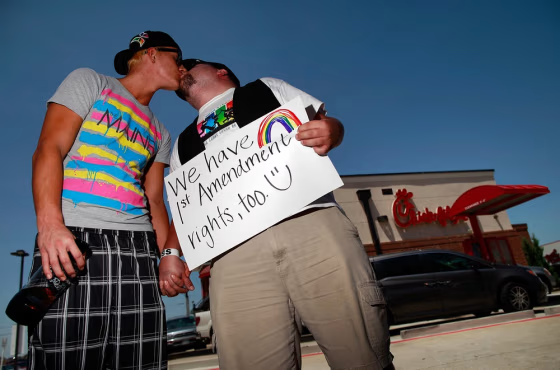
Austin has become the first city in Texas to officially support marriage equality in the Lone Star State.
This morning, the Austin City Council unanimously adopted a formal resolution "declaring the City Councils intent to support marriage equality in the State of Texas." The resolution was brought to the City Council after Equality Texas submitted a petition with over 1,800 signatures.
In a statement released Wednesday, Equality Texas argued that the passage of this resolution would send a message to the state and the country that Austin stands for equality.







 FOR SUBSCRIBERSA harrowing ordeal aboard an Israel-bound plane







FOR SUBSCRIBERSThe debate over AI’s future rages on both coasts

The Council resolution recognizes that marriage is a powerful and important affirmation of love and commitment and a source of social support and recognition. Passage of this resolution will send the message to state and national leaders that Austin is a community that values equality for all its citizens. The resolution will also send the message that the City of Austin believes all couples in loving and committed relationships should be given the opportunity to create stronger and more successful families through civil marriage.
Austin is already known as Texas' most progressive city, and has been associated with pro-marriage equality stances in the past. In 2005, when Texas voters amended the state's constitution to ban same-sex marriage and civil unions, Travis County (in which Austin sits) was the only county to oppose the amendment.
FOR SUBSCRIBERSA harrowing ordeal aboard an Israel-bound plane
FOR SUBSCRIBERSThe debate over AI’s future rages on both coasts
Although Texas is one of the 31 states with constitutional amendments that define marriage as being between a man and a woman, there have been challenges in recent history to the state's law. In 2009 during a divorce trial between two gay Texans married in Massachusetts, a Texas judge ruled the same-sex marriage ban unconstitutional, clearing the way for the two men to divorce and opening up other channels for advocates to challenge the ban. The following year, a Fifth Court of Appeals in Dallas reversed the ruling and said the ban did not violate the Fourteenth Amendment. Last year, a Third Court of Appeals in Austin issued another conflicting ruling that allowed a same-sex couple to divorce.
It is probably unlikely that the entire state of Texas will reverse its constitutional amendment anytime soon, considering the Texas Republican Party's strong hold on the state's leadership as well as their platform that includes numerous anti-equality points. But the resolution out of Austin, the capital of Texas and the state's fourth most populous city, is a huge symbolic step toward the progress that could come as the country's attitude slowly shifts in its view on marriage equality. A recent New York Times/CBS poll shows that the majority of Americans support legalizing same-sex marriage, 51% to 41%, and the gap between support/opposition is only widening (in July, the same poll found 46% support marriage equality as opposed to 44% who don't.)
A University of Texas/Texas Tribune poll in February found that three in five Texas voters supported some form of legal partner status for same-sex couples, with 31% in favor of same-sex marriage and 29% in favor of civil unions.