
TOKYO — Japan issued its first warning Thursday about the possibility of a long-feared "megaquake" after a powerful 7.1-magnitude temblor struck off its southern coast, sparking a tsunami advisory but no immediate reports of serious damage or injuries.
The earthquake occurred off the coast of Miyazaki Prefecture on the main island of Kyushu at 4:42 p.m. local time (3:42 a.m. ET), at a depth of about 18 miles, according to the Japan Meteorological Agency.
Three people were reported injured, Japan's Chief Cabinet Secretary Yoshimasa Hayashi said, although he added that there had been no blackouts or damage to the water or communications systems reported in the region. Police in Miyazaki Prefecture said there had been 10 reports of damage. Hayashi urged residents to stay away from the coastline.
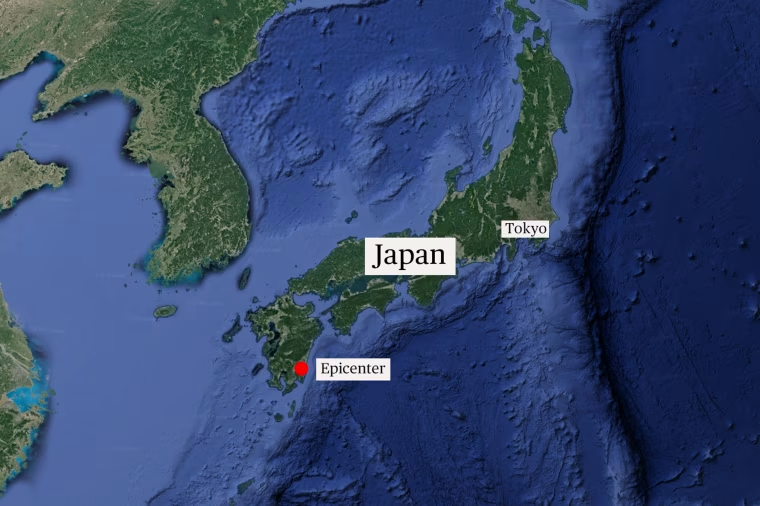
Seismologists held an emergency meeting to analyze whether the quake had affected the nearby Nankai Trough — the source of past devastating earthquakes. The meteorological agency ultimately issued what it called a "mega earthquake caution," assessing that the possibility of a large quake was relatively higher than usual but not that one would definitely occur in the near future. It urged the country's residents to practice increased vigilance for the next week.
"We ask all citizens to carefully check every new information issued by the government, reconfirm their daily earthquake preparedness, and be ready to evacuate immediately in the event of an earthquake," Prime Minister Fumio Kishida told a news briefing.
Earlier, officials issued a tsunami advisory following Thursday morning's quake, warning residents to immediately leave coastal areas of Kochi and Miyazaki prefectures until the warning is lifted. Advisories are issued when the waves are not expected to exceed 1 meter (3.3 feet).
Tsunami waves of up to 1.6 feet were detected along parts of Kyushu’s southern coast and the nearby island of Shikoku about a half hour after the quake struck. Japanese broadcaster NHK said Miyazaki Port had reported a surge of 20 inches.
That said, most of the damage so far has been relatively light. Police in Miyazaki Prefecture said there have been some reports of landslides and some traffic lights have stopped working. NHK said some windows were broken at the prefecture's airport and that the runway had been temporarily closed for checks.
Meanwhile, in neighboring Kagoshima Prefecture, concrete walls collapsed and a wooden house was damaged.
Of the people injured across the two prefectures, two are reported to be older women, who were taken to hospital after falling, while another was a female factory worker struck in the back by a falling object.
The Nuclear Regulation Authority said all 12 nuclear reactors on Kyushu and Shikoku remain safe. Earthquakes in areas with nuclear power plants have been a major concern since a massive 9.0-magnitude earthquake and ensuing tsunami triggered the Fukushima nuclear disaster in March 2011.
Japan sits on the Pacific 'Ring of Fire' — a line of seismic faults encircling the Pacific Ocean — and is one of the world’s most earthquake-prone countries. A temblor there Jan. 1 in Japan’s north-central region of Noto left more than 240 people dead.
Arata Yamamoto reported from Tokyo, and Jennifer Jett reported from Hong Kong.