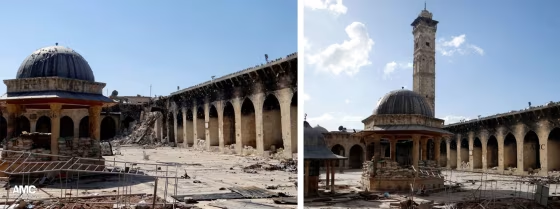
BEIRUT — The 11th-century minaret of a famed mosque that towered over the narrow stone alleyways of Aleppo's old quarter collapsed Wednesday as rebels and government troops clashed in the streets around it, depriving the ancient Syrian city of one of its most important landmarks.
President Bashar Assad's government and the rebels trying to overthrow him traded blame over the destruction to the Umayyad Mosque, a UNESCO world heritage site and centerpiece of Aleppo's walled Old City.
"This is like blowing up the Taj Mahal or destroying the Acropolis in Athens. This mosque is a living sanctuary," said Helga Seeden, a professor of archaeology at the American University of Beirut. "This is a disaster. In terms of heritage, this is the worst I've seen in Syria. I'm horrified."
Aleppo, Syria's largest city and a commercial hub, emerged as a key battleground in the nation's civil war after rebels launched an offensive there last summer. Since then, the fighting has carved the city into rebel- and regime-held zones, killed thousands of people, forced thousands more to flee their homes and laid waste to entire neighborhoods.
The Umayyad Mosque complex, which dates mostly from the 12th century, suffered extensive damage in October as both sides fought to control the walled compound in the heart of the old city. The fighting left the mosque burned, scarred by bullets and trashed. Two weeks earlier, the nearby medieval covered market, or souk, was gutted by a fire sparked by fighting.
With thousands of years of written history, Syria is home to archaeological treasures that date back to biblical times, including the desert oasis of Palmyra, a cultural center of the ancient world. The nation's capital, Damascus, is one of the oldest continually inhabited cities in the world.
At least five of Syria's six World Heritage sites have been damaged in the fighting, according to UNESCO, the U.N.'s cultural agency. Looters have broken into one of the world's best-preserved Crusader castles, Crac des Chevaliers, and ruins in the ancient city of Palmyra were damaged. Both rebel and regime forces have set up bases in some of Syria's significant historic sites, including citadels and Turkish bath houses, while thieves have stolen artifacts from museums.
The destruction of the minaret — which dated to 1090 and was the oldest surviving part of the Umayyad Mosque — brought outrage and grief.
"What is happening is a big shame," said Imad a-Khal, a 59-year-old Christian businessman in Aleppo. "Thousands of tourists used to visit this site. Every day is a black day for Syrians."







 FOR SUBSCRIBERSA harrowing ordeal aboard an Israel-bound plane







FOR SUBSCRIBERSThe debate over AI’s future rages on both coasts

FOR SUBSCRIBERSA harrowing ordeal aboard an Israel-bound plane
FOR SUBSCRIBERSThe debate over AI’s future rages on both coasts
The main Western-backed opposition group, the Syrian National Coalition, accused the government of intentionally committing "a crime against civilization and humanity" by destroying the minaret.
"The regime has done all it can to tear apart the Syrian social fabric," the Coalition said in a statement. "By its killings and destruction of heritage, it is planting bitterness in the hearts of the people that will be difficult to erase for a long time to come."
There were conflicting accounts about what leveled the minaret, leaving the once-soaring stone tower a pile of rubble and twisted metal scattered in the mosque's tiled courtyard.
Syria's state news agency said rebels from the al-Qaida-linked Jabhat al-Nusra group blew it up, while Aleppo-based activist Mohammed al-Khatib said a Syrian army tank fired a shell that "totally destroyed" the minaret.
Associated Press writers Barbara Surk and Bassem Mroue in Beirut, and Albert Aji in Damascus, Syria, contributed to this report.