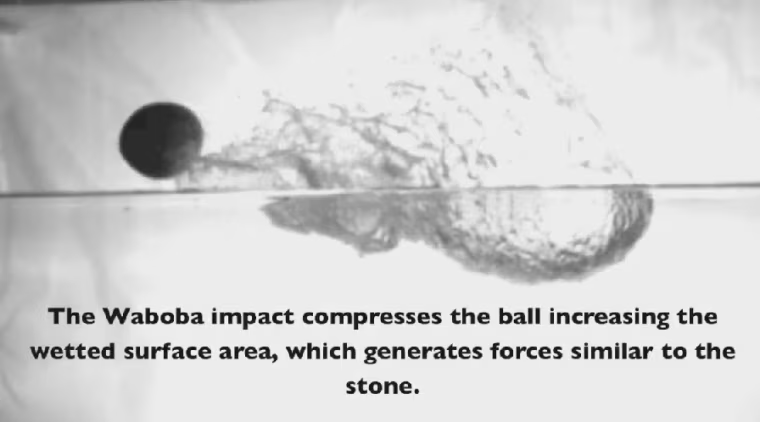
Some balls bounce on water, and some do it better than others. The best in class is the trademarked Waboba, which stands for water bouncing ball. And now a team of mechanical engineers has figured out why the Waboba works so well.
The team led by Michael Wright at Brigham Young University's Splash Lab in Provo, Utah, did this by attempting to skip three types of balls across the water, videotaping the activity, and analyzing the footage. Their results are posted on arXiv.org, including a video that explains it all.







 FOR SUBSCRIBERSA harrowing ordeal aboard an Israel-bound plane







FOR SUBSCRIBERSThe debate over AI’s future rages on both coasts

FOR SUBSCRIBERSA harrowing ordeal aboard an Israel-bound plane
FOR SUBSCRIBERSThe debate over AI’s future rages on both coasts
The tests involved a Superball, a racquetball and, of course, the Waboba.
"The way balls 'bounce' out of the water is they make a cavity that forms a sort of jump to allow them to rise out of the cavity," Tadd Truscott, the Splash Lab's director, explained to me in an email. "The Waboba is special because it is so deformable."
When it hits the water, it flattens out inside the cavity so that it becomes more like a skipping stone.
"Stones skip out of the cavities they make because they sort of slip across the surface and up the jump," Truscott said. "The Waboba does the same thing because it can flatten out so well."
By contrast, the Superball and racquetball don't deform as much and so aren't able to increase their surface area as they form the cavity, making it more difficult to skip out.
In fact, the Superball, which is a solid, stiff, and has a large ratio of mass relative to its size, plunged underwater even when thrown at a shallow angle, as we learned to do when skipping stones. It doesn't bounce at all.
The racquetball, which is hollow and has a much lower mass ratio, creates a small cavity and then rebounds quickly, but it kicks up a wave that it has to bust through, which slows it down. It bounces a little.
Meanwhile, the Waboba skips supremely across the water like a child let out of school for the summer.
"When you throw a Waboba, you can almost feel the difference or hear the difference as it hits the water, and it piqued my curiosity," Truscott noted, explaining what led him to do the experiment. "I wanted to know why it was behaving more like a stone than a ball."
While the study tickled the researchers' curiosities, the findings could also have real-world applications, he added, such as developing better landing craft for vehicles "that could both fly and move on the water surface."
More on skipping across the water:
- Rock on! Man breaks stone-skipping record
- The science of skipping stones
- Engineer builds robot that walks on water
- 12-legged robot walks on water
Last updated at 8:00 am PT Oct. 28.
John Roach is a contributing writer for msnbc.com. To learn more about him, check out his website. For more of our Future of Technology series, watch the featured video below.