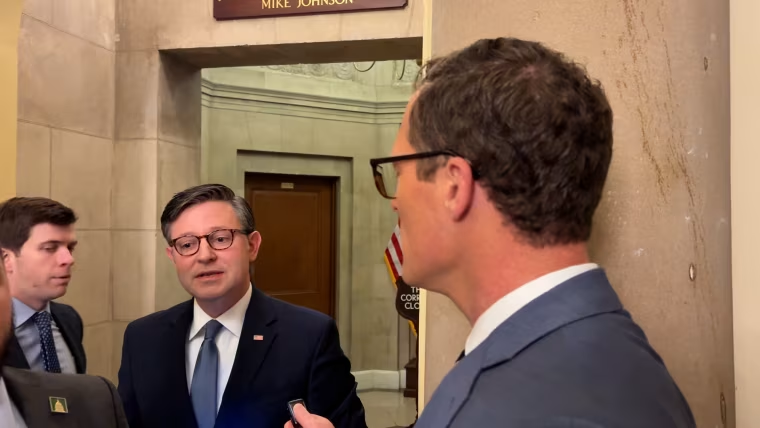
House Speaker Mike Johnson, R-La., said Thursday that it is not necessary for Congress to weigh in on the Trump administration’s military action in Iran because the United States is currently “not at war.”
“I don’t think we have an active, kinetic military bombing, firing or anything like that. Right now, we are trying to broker a peace,” Johnson told NBC News in the Capitol. “I would be very reluctant to get in front of the administration in the midst of these very sensitive negotiations, so we’ll have to see how that plays out.”
His comments come as the ongoing military conflict with Iran nears the 60-day mark, a threshold outlined in the 1973 War Powers Resolution, which says that the president has to remove military forces from conflict within 60 days if Congress doesn't authorize a war before that deadline.
When pressed about the 60-day deadline, which falls on Friday, Johnson specifically said, “We are not at war.”
He went on to say: “We’re policing the Strait of Hormuz and trying to get a peace. The president and the administration are moving as aggressively as possible. There’s nothing Congress can do to move that along any further, so we’ll see how it plays out. That is my position.”
The 1973 law also gives presidents the power to ask for a 30-day extension, though it's unclear whether President Donald Trump plans to do so this week.
Administration officials and leaders on Capitol Hill are in "active conversations" about how to handle the 60-day requirement outlined in the 1973 law, a senior White House official told NBC News.







 FOR SUBSCRIBERSA harrowing ordeal aboard an Israel-bound plane







FOR SUBSCRIBERSThe debate over AI’s future rages on both coasts

The official said that any members who voted against an authorization for the president’s war with Iran "would only undermine the United States military abroad."
Asked about the 60-day limit in a Senate hearing Thursday, Defense Secretary Pete Hegseth said: "I would defer to the White House and White House counsel on that. However, we are in a ceasefire right now, which, our understanding, means the 60-day clock pauses or stops in a ceasefire."
A senior administration official told NBC News on Thursday that“for War Powers Resolution purposes, the hostilities that began on Saturday, February 28 have terminated.”
Sen. Tim Kaine, D-Va., who had asked Hegseth about the deadline, responded, "I do not believe the statute would support that."
FOR SUBSCRIBERSA harrowing ordeal aboard an Israel-bound plane
FOR SUBSCRIBERSThe debate over AI’s future rages on both coasts
White House spokeswoman Anna Kelly said in a statement that “President Trump has been transparent with the Hill since before Operation Epic Fury began, and administration officials provided over 30 bipartisan briefings for Members of Congress to keep them apprised of military updates. The President’s preference is always diplomacy, and Iran wants to make a deal.”
Trump himself has repeatedly called the conflict with Iran a "war," among other terms. On Feb. 28, in his first remarks announcing the strikes on Iran, he said, "The lives of courageous American heroes may be lost, and we may have casualties. That often happens in war."
On March 9, he said, "I think the war is very complete, pretty much." A few days later, he said the operation was "both" a war and a "little excursion."
Later that month, he acknowledged that maybe he shouldn't call it a war, because "you are supposed to get approval" from Congress.
Nevertheless, in mid-April, he said during an interview on Fox Business, "I had to go to a war."
During an interview Thursday with Newsmax's Greta van Susteren, Trump said, “The stock market just now hit a new high during the war, or the military operation, whatever you’d like to call it."
On Wednesday, military leaders testifying before the House Armed Services Committee about their 2027 budget request made no indication that the ongoing military operation in Iran would be drawing to a close.
Acting Pentagon Comptroller Jules Hurst III testified that the war has cost $25 billion so far and added that the Trump administration planned to make a request to Congress for supplemental funding for the war.