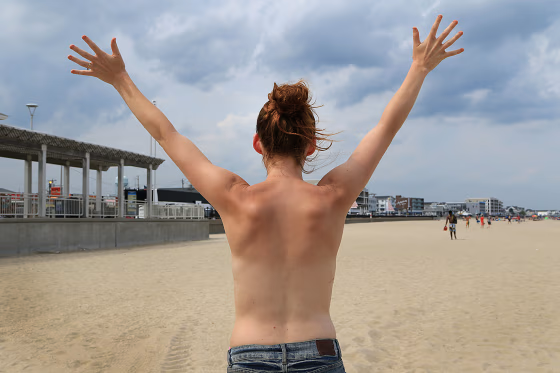
WASHINGTON — The Supreme Court said Monday that it will not take up a challenge to a New Hampshire city ordinance banning women from appearing topless in public.
A group with the motto "Free The Nipple" argued that the law violates the Constitution by treating men and women differently.
The legal dispute began in 2016 when Ginger Pierro did her yoga exercises topless at a lakeside beach in Laconia, New Hampshire, and was arrested for violating the city ordinance banning public nudity. It banned, among other things, "the showing of the female breast with less than a fully opaque covering any part of the nipple."
Three days later two other women, Heidi Lilley and Kia Sinclair, went to the same beach, appearing topless to protest the arrest. They, too, were charged with violating the nudity law.
All three challenged their convictions, arguing that topless bans are discriminatory because men can appear in public without their shirts. The bans also further the "sexualized objectification of women," according to their legal brief.
The New Hampshire Supreme Court rejected their challenge, acknowledging that the law treats men and women differently. But the sexes "are not fungible" with respect to the traditional understanding of what constitutes nudity. Public exposure of the female breast "almost invariably conveys sexual overtones," the state court said. Most lower courts have come to the same conclusion.







 FOR SUBSCRIBERSA harrowing ordeal aboard an Israel-bound plane







FOR SUBSCRIBERSThe debate over AI’s future rages on both coasts

A year ago, the federal appeals court for the 10th U.S. Circuit Court of Appeals struck down a topless ban in Fort Collins, Colorado. The ruling found no justification for treating men and women differently when they wish to bare their chests.
FOR SUBSCRIBERSA harrowing ordeal aboard an Israel-bound plane
FOR SUBSCRIBERSThe debate over AI’s future rages on both coasts
Society's sexualization, the court said, "has engrained in us the stereotype that the primary purpose for women's breasts is sex, not feeding babies." Such a stereotype, the ruling said, "serves the function of keeping women in their place."
Fort Collins decided not to appeal the decision, after spending more than $300,000 defending the law, and formally removed the law from its public nudity statute. The prohibition on public exposure of breasts by women and girls over 10 years old is no longer on the city's books.
