The District of Columbia has settled a lawsuit by a protester who said he was detained and handcuffed for following National Guard troops around the city while playing Darth Vader’s theme song from “Star Wars.”
The terms of the agreement were not immediately disclosed, but the American Civil Liberties Union, which represents demonstrator Sam O’Hara in the case, said in a press release that he was receiving compensation. The group did not immediately respond to a request for more details.
The D.C. mayor’s office referred questions to the local police and the D.C. attorney general’s office. Representatives for the Metropolitan Police Department and D.C. Attorney General Brian Schwalb did not immediately respond to requests for comment.
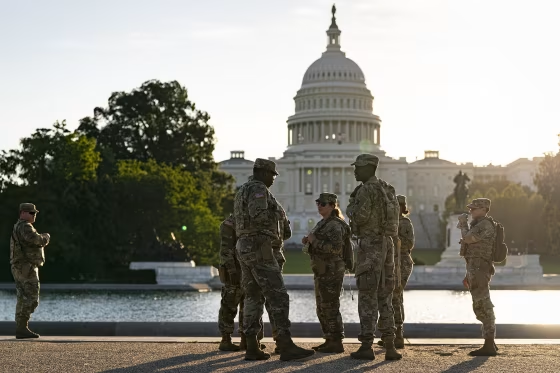
The incident happened in Sept. 2025, when O’Hara, a D.C. resident, was protesting against President Donald Trump’s decision to send National Guard troops to the city, and did so with music.
“In the Star Wars franchise, The Imperial March is the music that plays when Darth Vader or other dark forces enter a scene or succeed in their dastardly plans. It is also the soundtrack of Sam O’Hara’s protest against the National Guard deployment in D.C.,” his lawsuit said.
“Mr. O’Hara was deeply concerned about the normalization of troops patrolling D.C. neighborhoods. And so, he began protesting the Guard members’ presence by walking several feet behind them when he saw them in the community. Using his phone and sometimes a small speaker, he played The Imperial March as he walked, keeping the music at a volume that was audible but not blaring,” his suit said.
He recorded the encounters and posted the videos on TikTok, which have racked up millions of views. One of his targets, Ohio National Guard member Sgt. Devon Beck, “was not amused by this satire,” the suit said.
“In less than two minutes, Sgt. Beck turned around and threatened to call D.C. police officers to ‘handle’ Mr. O’Hara if he persisted. Mr. O’Hara continued recording,” the filing said.
Beck made good on his warning, and four Metropolitan Police officers responded and detained and cuffed O’Hara, according to the lawsuit.
“The law might have tolerated government conduct of this sort a long time ago in a galaxy far, far away,” the suit said, referencing the opening credits of Star Wars. “But in the here and now, the First Amendment bars government officials from shutting down peaceful protests.”







 FOR SUBSCRIBERSA harrowing ordeal aboard an Israel-bound plane






FOR SUBSCRIBERSThe debate over AI’s future rages on both coasts
FOR SUBSCRIBERSA harrowing ordeal aboard an Israel-bound plane
FOR SUBSCRIBERSThe debate over AI’s future rages on both coasts
O’Hara filed suit against Beck, the officers and the city for violating his constitutional rights.
The settlement does not end the suit; O’Hara’s claims against Beck are still pending. The Justice Department has argued that his actions are protected by qualified immunity and the claims should be dismissed.
The government also complained that O’Hara was “broadcasting distracting music.”
“Beck could reasonably perceive that conduct as interfering with the patrol’s movement and situational awareness, because an armed patrol must attend to nearby persons, maintain the ability to hear, and move without a civilian trailing it at close range,” DOJ attorneys argued.
“Moreover, Beck and his fellow Guardsmen could have reasonably felt harassed by Plaintiff and concerned that he was following them and ignoring their requests to stop” and concerned about O’Hara’s “conduct creating a reasonable fear of imminent harm,” they added.
A spokesperson for the Justice Department declined to comment. A representative for the Ohio National Guard did not immediately respond to a request for comment on the city’s settlement.
