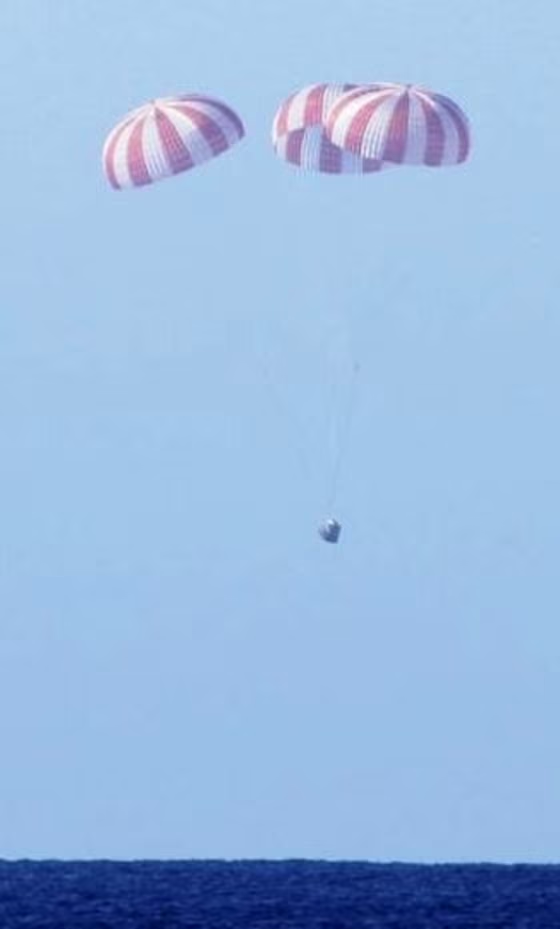
SpaceX reports that its Dragon spaceship has come down from orbit, made it through atmospheric re-entry, opened its parachutes and splashed down into the Pacific Ocean as planned.
"SPLASHDOWN!!!" SpaceX reported in a single-word Twitter update. In its own update, NASA's Johnson Space Center reported that "Dragon has splashed down on target."
Today's mission represented the Dragon's maiden test flight. The two-orbit circuit was the first in-space tryout for a craft that's meant to resupply the International Space Station after next year's scheduled retirement of NASA's space shuttle fleet. Unless something went horribly wrong while the gumdrop-shaped craft was in orbit (interdimensional wormhole?), the mission can be considered fully successful.

 FOR SUBSCRIBERSCBP leaders cut out of Trump ad buy decision









FOR SUBSCRIBERSA harrowing ordeal aboard an Israel-bound plane





In a follow-up tweet, California-based SpaceX said it was "the first commercial company to re-enter a spacecraft from space." Actually, another California company, Scaled Composites, accomplished that feat in 2004 with the suborbital SpaceShipOne rocket plane. But SpaceX was the first to return a private-sector craft from orbit.
(Of course, commercial enterprises have had a hand in building all of NASA's spacecraft, and SpaceX is relying on $278 million in NASA funding for Falcon/Dragon development -- but I hope you know what I mean. In this case, NASA is the client, not the operator. Mission control was run by SpaceX, not NASA. The rocket and the capsule featured SpaceX's logo, not NASA's.)
FOR SUBSCRIBERSCBP leaders cut out of Trump ad buy decision
FOR SUBSCRIBERSA harrowing ordeal aboard an Israel-bound plane
A SpaceX news conference is expected at NASA's Kennedy Space Center later today.
Stay tuned for updates on the Dragon's maiden space mission by checking Twitter (via @b0yle or @SpaceXer), or checking Cosmic Log's SpaceX coverage.