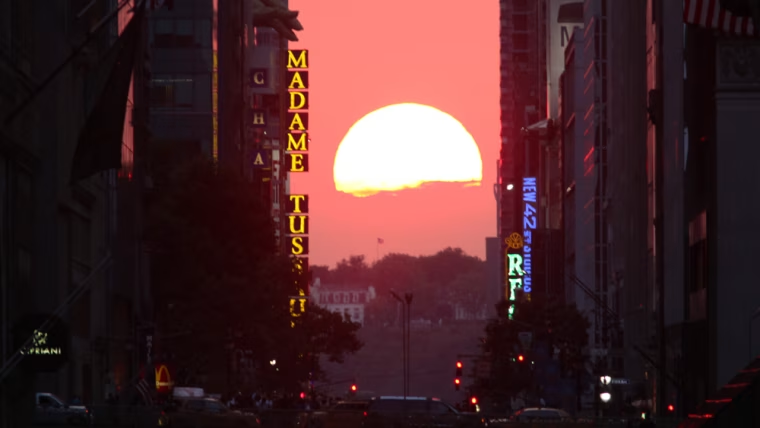
Manhattanhenge is a state of mind as well as a photo op — so even if the skies are too stormy to see the sun set precisely between New York's skyscrapers, it's still nice to know that it's happening beyond the clouds. And besides, there's always tomorrow ... or July.
Some of Manhattan's best-known east-west streets are aligned so that the buildings on each side frame the setting sun twice a year, on either side of the summer solstice. This year, the appointed days are Tuesday and Wednesday of this week, as well as July 12 and 13. Neil deGrasse Tyson, director of New York's Hayden Planetarium, notes that the dates roughly line up with Memorial Day and baseball's All-Star break.
"Future anthopologists might conclude that, via the sun, the people who called themselves Americans worshiped War and Baseball," he jokes in his guide to Manhattanhenge.

 FOR SUBSCRIBERSCBP leaders cut out of Trump ad buy decision









FOR SUBSCRIBERSA harrowing ordeal aboard an Israel-bound plane





The phenomenon takes place only on specific dates because the point on the horizon where the sun sets creeps northward ever so slightly from the winter to the summer solstice, then creeps back south from summer to winter. The May and July dates happen to mark the times when the point of sunset lines up prettily with Manhattan's main street grid, which is aligned 30 degrees east from geographic north. Tyson reports that a half-sun lines up with the streets at 8:16 p.m. ET Tuesday and at 8:24 p.m. ET July 13, while the full sun hovers just over the horizon at 8:15 p.m. ET Wednesday and 8:23 p.m. ET July 12.
When the weather is clear, hundreds of New Yorkers throng to see the sight. Unfortunately, this week's forecast calls for thundershowers on Tuesday night, and isolated thunderstorms on Wednesday. Nevertheless, some hardy souls may still hang out in hopes of a break. Here's a typical tweet, from Hilary Ann Martin: "Rain, rain go away. You're going to ruin my #Manhattanhenge day."
FOR SUBSCRIBERSCBP leaders cut out of Trump ad buy decision
FOR SUBSCRIBERSA harrowing ordeal aboard an Israel-bound plane
If you're a New Yorker facing a rained-out Manhattanhenge, keep those July dates in mind. And if you're living somewhere else, keep in mind that different cities have different sunset "henges," depending on the alignment of their street grids: They're roughly around March 21 and Sept. 21 for Chicago; April 4 and Sept. 5 for Philadelphia; and Feb. 16 and Oct. 23 for Toronto. Be forewarned, though: There's no modern henge quite like Manhattanhenge.
More celestial alignments:
- 2012: Manhattanhenge wows New Yorkers
- Astronomical alignment found at Peru pyramid
- Feast your eyes on a new Stonehenge theory
If you catch a Manhattanhenge picture, either this week or in July, please share it with us via NBC News' FirstPerson photo upload page.
Alan Boyle is NBCNews.com's science editor. Connect with the Cosmic Log community by "liking" the NBC News Science Facebook page, following @b0yle on Twitter and adding the Cosmic Log page to your Google+ presence. To keep up with NBCNews.com's stories about science and space, sign up for the Tech & Science newsletter, delivered to your email in-box every weekday. You can also check out "The Case for Pluto," my book about the controversial dwarf planet and the search for new worlds.