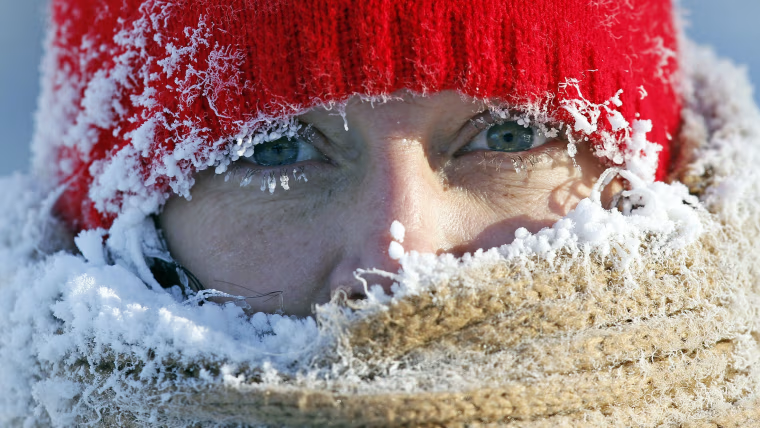
Remember the polar vortex, the huge mass of Arctic air that can plunge much of the U.S. into a deep freeze? A new study says that as the world gets warmer, parts of North America, Europe and Asia could see more frequent and stronger visits of that cold air. Shrinking ice in the seas off Russia leaves more water uncovered, allowing more energy to enter the atmosphere and weakening the jet stream, which usually keeps Arctic air from wandering south, said study co-author Jin-Ho Yoon of the Pacific Northwest National Laboratory in Richland, Washington.







 FOR SUBSCRIBERSA harrowing ordeal aboard an Israel-bound plane







FOR SUBSCRIBERSThe debate over AI’s future rages on both coasts

FOR SUBSCRIBERSA harrowing ordeal aboard an Israel-bound plane
FOR SUBSCRIBERSThe debate over AI’s future rages on both coasts
In the study, published Tuesday in Nature Communications, scientists from South Korea and United States found that many such cold outbreaks happened a few months after unusually low sea ice levels off Russia. The study saw the same link using historical data and computer simulations, according to lead author Baek-Min Kim of the Korea Polar Research Institute. Sea ice in the Arctic reached a record low in 2012; it's slightly up this year. Kevin Trenberth, climate analysis chief at the National Center for Atmospheric Research in Boulder, is skeptical. His research points more to the Pacific for changes in the jet stream and polar vortex behavior.
IN-DEPTH
- This Year's Weather May Be Most Unusual on Record
- What's Melting the Glaciers? You Are, Study Says
- Are Siberian Holes the Result of Climate Change?