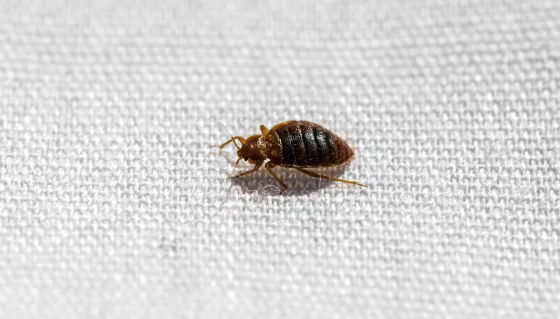
As the old saying goes, “Don’t let the bed bugs bite.”
But according to a new study, the bugs have been nipping humans since they emerged from caves around 60,000 years ago, making them possibly the “first true urban pest.”
Evidence of our symbiotic relationship with the blood-sucking parasites could now inform predictive models for the spread of pests and diseases as cities explode in population, researchers said in the study published Wednesday in the journal Biology Letters.
Through genetic analysis, the researchers from Virginia Tech found that populations of both bat-related bed bugs and the ones that jumped over to humans continued to decline till the last ice age, about 20,000 years ago.
That's where the two lineages begin to diverge.
“The really exciting part is that the human-associated lineage did recover and their effective population increased,” Lindsay Miles, lead author of the study and a postdoctoral fellow in the department of entomology at Virginia Tech, said in a news release Wednesday.
Around 12,000 years ago, when humans began building large settlements that expanded into cities such as Mesopotamia, the number of bed bugs also increased, the study said, adding that the creatures, which live in furniture and feed off blood, predate rats and cockroaches as domestic pests.

 FOR SUBSCRIBERSCBP leaders cut out of Trump ad buy decision









FOR SUBSCRIBERSA harrowing ordeal aboard an Israel-bound plane





The bat bed bug species fell away, the study said.
FOR SUBSCRIBERSCBP leaders cut out of Trump ad buy decision
FOR SUBSCRIBERSA harrowing ordeal aboard an Israel-bound plane
The study of demographic patterns provides "compelling evidence that the human-associated lineage closely tracked the demographic history of modern humans and their movement into the first cities,” researchers added.
“There were bed bugs living in the caves with these humans, and when they moved out they took a subset of the population with them so there’s less genetic diversity in that human-associated lineage,” said Warren Booth, an associate professor of urban entomology at Virginia Tech, who also authored the study.
The team wanted to look at how the “effective population size,” or the number of breeding individuals contributing to the next generation, changed over time, “because that can tell you what’s been happening in their past,” Miles said.
The earliest human civilizations emerged around 10,000 years ago and provided ideal conditions for the "spread of commensal urban pests," Miles and Booth wrote in their findings, adding that this raises questions about whether commensal relations between humans and other pests could have also emerged earlier.