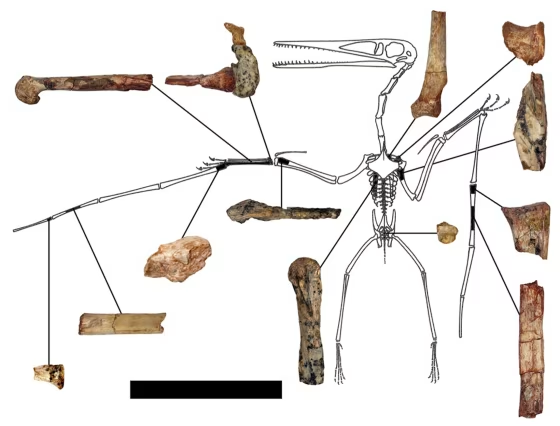
A Chinese fossil is the earliest and most primitive pterodactyloid, part of a group of flying reptiles that ruled the skies some 163 million years ago, scientists report.
Winged creatures called pterosaurs evolved from a primitive form that lived about 228 million years ago into the largest flying creatures that ever existed. The new specimen helps fill in an important gap in that evolution, researchers say.
"This guy is the very first pterodactyloid — he has the last features that changed before the group radiated and took over the world," said paleontologist Brian Andres of the University of South Florida, a co-author of the study detailed today (April 24) in the journal Current Biology. [ Photos of Pterosaurs: Flight in the Age of Dinosaurs ]
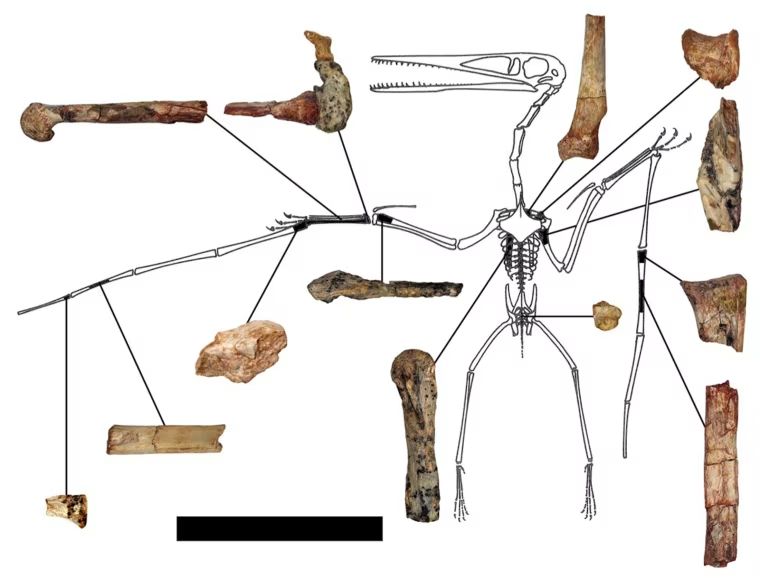
(Researchers avoid calling pterodactyloids "pterodactyls," because the term is sometimes used to mean all pterosaurs and sometimes to mean just pterodactyloids, which include members of one of two suborders of pterosaurs.)
The finding extends the fossil record of pterodactyloids by at least 5 million years, to the Middle-Upper Jurassic boundary 163 million years ago, Andres told Live Science.
Pterodactyloids are not ancestors of modern birds, which evolved from feathered dinosaurs.







 FOR SUBSCRIBERSA harrowing ordeal aboard an Israel-bound plane







FOR SUBSCRIBERSThe debate over AI’s future rages on both coasts

FOR SUBSCRIBERSA harrowing ordeal aboard an Israel-bound plane
FOR SUBSCRIBERSThe debate over AI’s future rages on both coasts
Scientists named the new species Kryptodrakon progenitor, meaning "ancestral hidden serpent," because it was found in the area where the movie "Crouching Tiger, Hidden Dragon" was filmed.
But this creature was no fearsome dragon. "He is a small guy, and [the fossil is] very fragmentary," Andres said.
The researchers analyzed the fossil fragments and found that Kryptodrakon had a wingspan of about 4.5 feet (1.4 meters), a far cry from the creature's enormous descendants, whose wingspans stretched up to 30 feet (9 m) — as large as a small airplane.
Andres' colleagues discovered the fossil in a mudstone of the Shishugou Formation in northwest China on an expedition in 2001.
— Tanya Lewis, Live Science
This is a condensed version of a report from Live Science. Read the full Live Science report.
Follow Tanya Lewis on Twitter and Google+. Follow us @livescience, Facebook & Google+.