The zebrafish is ready for its close-up. Researchers captured video of the fish's lateral line — the equivalent of the inner ear in humans — which lets it sense movement in the surrounding water. It was impressive enough to win first place at the fourth annual Nikon Small World in Motion Photomicrography Competition, which features time-lapse footage taken through microscopes.
The video shows how genetic markers can be used to reveal how sensory hair cells develop in the zebrafish's lateral line. The Spanish researchers behind the video, Mariana Muzzopappa and Jim Swoger, say this up-close look at the process could help scientists find a cure for deafness in humans.
The contest featured lots more stunning footage: To win second place, Douglas Clark, of San Francisco-based Paedia Corp., condensed 20 minutes of imagery into40 seconds of video that shows caffeine crystals forming in water.
















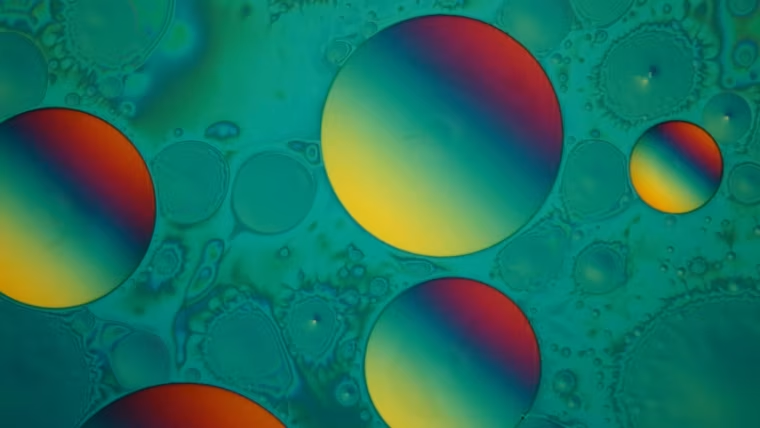
John Hart, a professor of atmospheric and oceanic sciences the University of Colorado at Boulder, won third place by recording how oil evaporates and coalesces on the surface of water. His work on "complex microscopic fluid dynamics" could be useful to researchers studying the longevity of oil spills.
Fourteen entries, documenting processes ranging from fruit fly locomotion to sulfur crystal formation, won honorable mentions. Here's the full list.
Sitting in front of a microscope right now? Submissions for the next Small World in Motion contest are due on April 30. If you need further inspiration, check out the most recent winners of the Nikon Small World contest for still photography, the top entries in the Olympus BioScapes contest, this year's "Vizzie" awards for scientific visualization and a sampler from last year's "Art of Science" exhibition.
