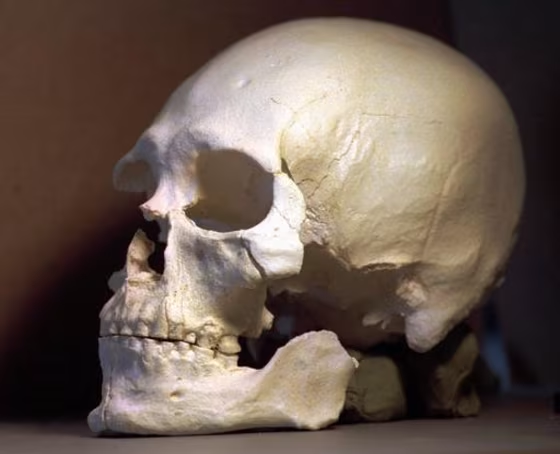
For 18 years, scientists have puzzled over the 9,000-year-old bones of an early American known as Kennewick Man — and Native American tribes have sought to get those bones returned for reburial. Now, a 680-page book with contributions from dozens of authors lays out their best guesses as to the controversial skeleton's origins. Their analysis suggests that the 5-foot-7 man came down to Washington state from the Far North, relied primarily on a diet of fish and seals, and drank from glacier-fed streams.
















"Kennewick Man: The Scientific Investigation of an Ancient American Skeleton" was edited by Douglas Owsley of the Smithsonian's National Museum of Natural History and forensic anthropologist Richard Jantz. Considering Owsley's affiliation, it's natural for Smithsonian Magazine to have the details. The skeleton, found on the banks of the Columbia River in 1996, was the subject of a years-long legal clash involving scientists, tribal leaders and the federal government. For now, the bones are considered the property of the U.S. Army Corps of Engineers and are held at the University of Washington's Burke Museum in Seattle.
IN-DEPTH
- Bones Tell Ancient Tale of Kennewick Man
- 12,000-Year-Old Girl's DNA Reveals First Americans' Roots
- Kennewick Man Freed to Share His Secrets (Smithsonian)