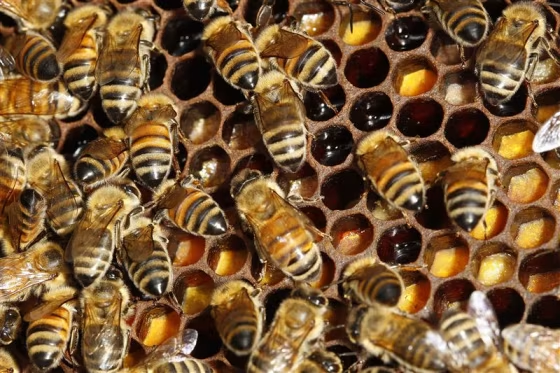
SYDNEY, Australia — Australian scientists are gluing tiny sensors onto thousands of honeybees to track their movements in a trial aimed at halting the spread of diseases that have wiped out populations in the Northern Hemisphere.
Scientists at the Commonwealth Scientific and Industrial Research Organisation (CSIRO), Australia's national science agency, said the microchips could help tackle so-called colony collapse disorder, a situation where bees mysteriously disappear from hives, and the encroachment of the parasitic varroa mite.
Scientists will use tweezers to glue on the sensors, weighing about 5 milligrams and measuring 2.5 millimeters (a little more than 1/16 of an inch) square, after soothing the bees to sleep by refrigeration.
Some young bees, which tend to be hairier than older bees, need to be shaved before the sensor can be glued on.
Scientists will examine the effectiveness of pesticides in protecting the bees from colony collapse disorder and varroa mite.
The study will also enable farmers and fruit growers to understand and manage their crops, given the honeybee's crucial role in the pollination of crops globally, the CSIRO said in a statement issued on Wednesday.
"Honeybees play a vital role in the landscape through a free pollination service for agriculture, which various crops rely on to increase yields," the CSIRO's Paulo de Souza, who is leading the project, said in the statement.







 FOR SUBSCRIBERSA harrowing ordeal aboard an Israel-bound plane







FOR SUBSCRIBERSThe debate over AI’s future rages on both coasts

"Using this technology, we aim to understand the bee's relationship with its environment."
FOR SUBSCRIBERSA harrowing ordeal aboard an Israel-bound plane
FOR SUBSCRIBERSThe debate over AI’s future rages on both coasts
Scientists plan to fit sensors on 5,000 bees in the southern island state of Tasmania over the Australian summer.
The radio frequency identification sensors work like an electronic tag for cars on a toll road, recording when insects pass a checkpoint. That will allow scientists to build a three-dimensional image of the insects' movements, a process described as "swarm sensing."
The scientists are working on shrinking the sensor to 1 mm square so they can be attached to smaller insects, including mosquitoes.