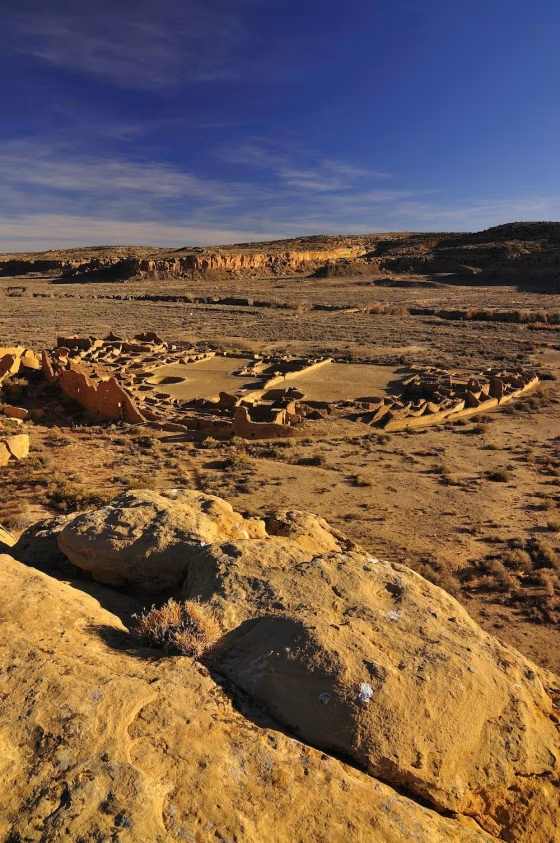
For hundreds of years, Native Americans in the southwestern United States had a prolonged baby boom — which would average out to each woman giving birth to more than six children, a new study finds. That baby streak, however, ended a little before the Spanish colonized the Americas.
"Birthrates were as high, or even higher, than anything we know in the world today," said study co-author Tim Kohler, an archaeologist and anthropologist at Washington State University.
The precolonial baby boom was likely fueled by Native Americans in the region switching from a nomadic, hunter-gathering lifestyle to a settled farming way of life, Kohler said. [ Images: Maya Maize Secrets Revealed In Tikal Soil ]
Sign up for top Science news delivered direct to your inbox
The researchers analyzed thousands of skeletal remains from hundreds of sites across the Four Corners region of the Southwest (the area that now makes up Utah, Arizona, New Mexico and Colorado) dating from 900 B.C. until the beginning of the colonial period in the early 1500s. (Most sites were excavated decades ago, and most of the remains have been returned to their tribes, Kohler said.)
By estimating the fraction of the population between ages 5 and 19 (young children's remains are too poorly preserved to include in the calculation), the researchers could get a rough estimate of the birthrate, or the number of babies born per year for every 1,000 people.
















The birthrate slowly increased until about A.D. 500, and then rose more quickly and stayed high until A.D. 1300. The birthrate, about 0.049 in a year, was akin to that in modern-day Niger, where every woman has, on average, 6.89 children.
The findings were published Monday (June 30) in the journal Proceedings of the National Academy of Sciences.
— Tia Ghose, LiveScience
This is a condensed version of a report from Live Science. Read the full report. Follow Tia Ghose on Twitter and Google+. Follow Live Science @livescience, Facebook & Google+.