Geologists hauling hundreds of pounds of 250-million-year-old rocks from Siberia, through Russian and American customs, say luck was on their side. Not only did they successfully transport the huge haul, but they also may have confirmed the cause of Earth's worst mass extinction.
The culprit? Catastrophic volcanic eruptions that spewed enough lava to cover Australia led to the die-off at the end of the Permian era, the researchers found. That die-off occurred about 250 million years ago and was the greatest mass extinction in Earth's history; 90 percent of marine species and 75 percent of land dwellers were wiped off the face of the planet over the course of about 60,000 years.
Ancient volcanic rocks now provide the best evidence yet that catastrophic volcanic activity triggered the extinction, researchers say.
Related: Deadliest Predator: Humans Wiped Out Ancient Mammals, Study Finds
"The main question we and many other research teams are trying to answer is, 'What causes mass extinction?'" said study lead author Seth Burgess, a geochronologist at the U.S. Geological Survey in Menlo Park, California. "These events shape the evolutionary trajectory of life on our planet, and are thus some of the most important events to occur in the 600 million years that complex life has inhabited Earth." [Wipe Out! History's 7 Most Mysterious Extinctions]
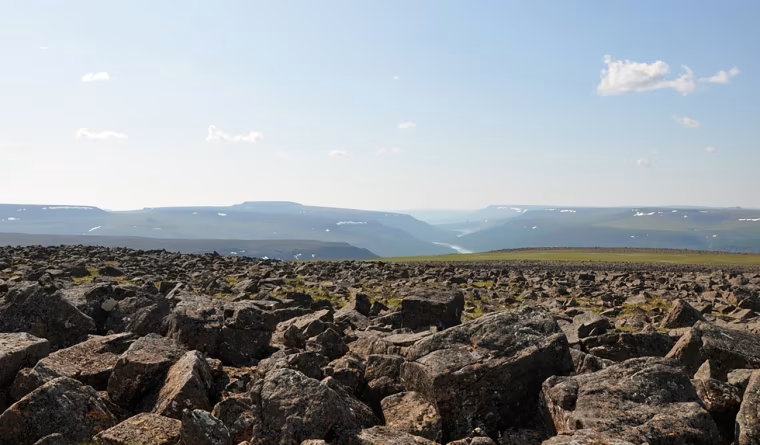
Scientists knew that a key factor behind this disaster may have been one of the biggest continental volcanic eruptions on record. It occurred in what is now Siberia, currently called the Siberian Traps, and spewed out as much as 2.7 million square miles (7 million square kilometers) of lava. This magmatism, or movement of magma, may have injected massive amounts of global warming gases into the atmosphere, wreaking havoc on the environment. These eruptions also led to acid rain that may at times have made the ground as acidic as lemon juice.
Related: Scientists Build Case for 'Sixth Extinction' ... and Say It Could Kill Us

 FOR SUBSCRIBERSCBP leaders cut out of Trump ad buy decision









FOR SUBSCRIBERSA harrowing ordeal aboard an Israel-bound plane





FOR SUBSCRIBERSCBP leaders cut out of Trump ad buy decision
FOR SUBSCRIBERSA harrowing ordeal aboard an Israel-bound plane
However, until now, scientists could not pinpoint when exactly the mass extinction and eruptions happened in relation to each other. To settle whether the mass extinction followed the eruptions, researchers investigated crystals within ancient volcanic rocks from 21 sites in Siberia.
"Getting to arctic Siberia isn't easy, and getting many hundreds of kilos of rock back through Russian and American customs is no picnic, either," Burgess told Live Science. "I consider getting all the samples back that we did a mixture of luck and preparedness."
The scientists found that the eruptions started about 300,000 years before the mass extinction, continued during the die-off and lasted for at least 500,000 years after species stopped dying off. Most of the lava, about two-thirds of the total, spewed out before and during the mass extinction.
"We are now able to resolve the relative timing of magmatism and mass extinction, and can finally say with confidence that magmatism precedes mass extinction, and by how much," Burgess said.
Burgess and his colleague Samuel Bowring, a professor of geology at the Massachusetts Institute of Technology, detailed their findings online Friday (Aug. 28) in the journal Science Advances.
This is an abbreviated version of a report from Live Science. Read the full report. Follow us @livescience, Facebook & Google+.
More from Live Science
- The 10 Biggest Volcanic Eruptions in History
- 6 Extinct Animals That Could Be Brought Back to Life
- Top 10 Ways to Destroy Earth
Copyright 2015 LiveScience, a Purch company. All rights reserved. This material may not be published, broadcast, rewritten or redistributed.