The Southern San Andreas fault may not be as dangerous as previously thought — at least for the towns and cities directly to the west of it.
New three-dimensional modeling shows that instead of being oriented straight up and down, the fault, which runs roughly northwesterly through the Coachella Valley, dips 60-70 degrees to the northeast, according to a study published in Geosphere.
For the cities to the west of the fault, such as Palm Springs and Palm Desert, that could mean shaking will be less violent during the big earthquake that inevitably will rattle the region. That’s because as the fault goes deeper, it moves away from the cities and closer to a far less densely populated area.
“Other studies that have simulated what would happen during earthquakes on a dipping fault found that with geometry like this, the west side would shake less,” says study coauthor Michele Cooke, a professor of geosciences at the University of Massachusetts, Amherst.
In fact, Cooke says, those studies show that the ground on the west side could shake half as much if the fault dipped, while the ground on the east side could shake twice as much. Overall, there would be a slight increase in ground shaking because the dipping fault would cover more area than a vertical fault.
This segment of the San Andreas appears to be long overdue for a big event. The recurrence interval has been calculated to be between 150 and 300 years and it’s been about 340 years since the last large earthquake roared through the region.
Cooke and her colleagues used models that were constrained by the overall plate motions and fault geometry. They ran three different versions: one with a vertical fault, one with a fault that was partially vertical and partially dipping and one that only dipped. They found that the model with a dipping fault best fit the patterns of uplift that have been measured in the region.

 FOR SUBSCRIBERSCBP leaders cut out of Trump ad buy decision









FOR SUBSCRIBERSA harrowing ordeal aboard an Israel-bound plane





Though that news may be good for cities nearest the fault zone, it’s not clear whether the dip of the fault will make much difference to Los Angeles and its neighbors, Cooke says.
Recent research has suggested that a big earthquake in the Coachella Valley could lead to strong shaking in Los Angeles, even though there are many miles between the two. That’s because of the structure of the Los Angeles basin, Cooke says.
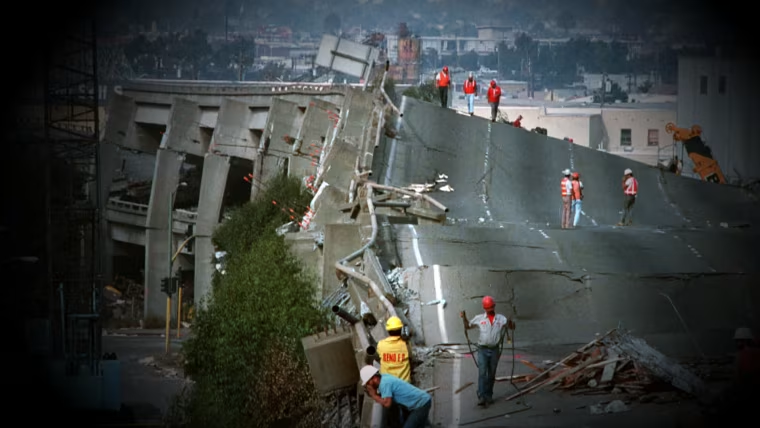
There is a study “that suggests that the waves could get trapped in the Los Angeles Basin and could keep shaking and shaking,” Cooke said. “The worst-case scenario is if a city sits on sediments that are very thick. Los Angeles is sitting on 10 km of soft sediment and that is why an earthquake in the Coachella Valley could produce a lot of shaking there even though it’s very far away.”
FOR SUBSCRIBERSCBP leaders cut out of Trump ad buy decision
FOR SUBSCRIBERSA harrowing ordeal aboard an Israel-bound plane
Frank Vernon, a research seismologist at the Scripps Institute of Oceanography, agrees that a dipped orientation probably won’t make much difference to Los Angeles. The effects of the dip would most likely only be felt locally, he said.
The one factor that might make a difference, Vernon said, is the direction in which the fault ruptures. If it starts in the north and propagates south, that would might lessen the shaking the city experiences.