Eight nations have signed on to become founding members of NASA's Artemis Accords, an international agreement that establishes how countries can cooperate to peacefully and responsibly conduct exploration of the moon.
NASA announced Tuesday that the United States signed the accords, together with Australia, Canada, Italy, Japan, Luxembourg, the United Arab Emirates and the United Kingdom. NASA Administrator Jim Bridenstine said the agreement would establish a “singular global coalition” to guide future expeditions to the moon.
“With today’s signing, we are uniting with our partners to explore the moon and are establishing vital principles that will create a safe, peaceful and prosperous future in space for all of humanity to enjoy,” Bridenstine said in a statement released Tuesday.
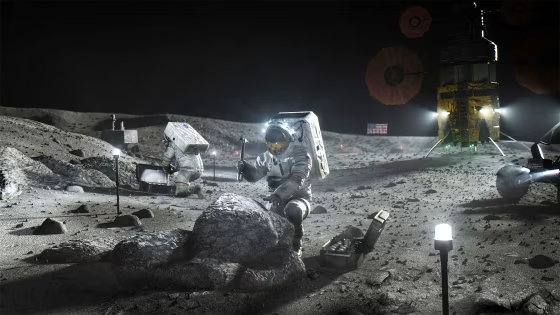
NASA developed the Artemis Accords to partner with other nations to set basic principles to guide robotic and crewed lunar exploration. The agreement’s name refers to NASA’s Artemis program, which aims to send astronauts, including the first woman, to the moon by 2024.
The accords include provisions for peaceful exploration, safety, transparency, sustainable use of space resources, cooperation to build and operate spacecraft and other hardware, and the management and disposal of orbital debris.

“Fundamentally, the Artemis Accords will help to avoid conflict in space and on Earth by strengthening mutual understanding and reducing misperceptions,” Mike Gold, NASA’s acting associate administrator for international and interagency relations, said in a statement. “The Artemis journey is to the moon, but the destination of the Accords is a peaceful and prosperous future.”
The Artemis Accords build on another major international agreement known as the Outer Space Treaty, which was enacted in 1967. The Outer Space Treaty bans the use of nuclear weapons or any other weapons of mass destruction in space and establishes that exploration of space, the moon and other celestial bodies should only be for peaceful purposes.
Related

The Outer Space Treaty was endorsed by the United Nations General Assembly in December 1966 and it has since been signed by 110 countries.
Unlike the Outer Space Treaty, the Artemis Accords are not binding, and there’s no formal way to enforce the rules set out in the agreement.
And not all countries that have lunar ambitions have signed the accords, though NASA said other countries are expected to join the agreement in the coming months and years. Dmitry Rogozin, the head of Russia’s space program Roscosmos, has been a vocal critic.
When the Artemis Accords were first announced, Rogozin compared the agreement to an invasion. During a virtual news conference this week at the International Aeronautical Congress, Rogozin also stated that Russia will not take part in NASA’s Artemis program because it is “too U.S.-centric.”
