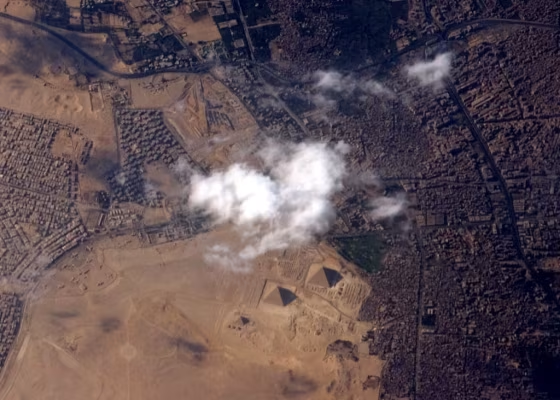
For more than three months, NASA astronaut Reid Wiseman has been chronicling subjects ranging from auroral lights to spaceship departures, and on Friday it was time for a little archaeology from above.

 FOR SUBSCRIBERSCBP leaders cut out of Trump ad buy decision









FOR SUBSCRIBERSA harrowing ordeal aboard an Israel-bound plane





"No doubt about it, those are some GREAT Pyramids at Giza," Wiseman wrote in his Twitter caption for a view of the pyramids and Cairo's urban sprawl, as seen from the International Space Station.
The 4,500-year-old monuments have often been photographed from orbit. Here's a shot taken virtually straight down from the space station back in 2012. But the view never gets old, and the debate over how the Egyptians did it continues to this day. Did they drag all those massive stone blocks across the desert, perhaps after wetting the sand, or did they make use of some novel engineering tricks?

FOR SUBSCRIBERSCBP leaders cut out of Trump ad buy decision
FOR SUBSCRIBERSA harrowing ordeal aboard an Israel-bound plane
Last week, the Physics ArXiv Blog featured a study proposing that the builders tied wooden dowels onto the blocks and rolled them to the construction site. They even field-tested the technique, though not on the Nile.
"It would seem that some variation of rolling the blocks should now be considered to be among the 'best' and most likely method used to move the stones for the great pyramids," Indiana State University's Joseph West and his colleagues write. That's something for Wiseman to ponder as the engineering wonder of the 21st century sails above the engineering wonder of the 25th century B.C.