Jupiter's icy moon Europa, regarded as perhaps the solar system's best bet to host alien life, keeps getting more and more interesting.
Big slabs of ice are sliding over and under each other within Europa's ice shell, a new study suggests. The Jovian satellite may thus be the only solar system body besides Earth to possess a system of plate tectonics.
"From a purely science or geological perspective, this is incredible," study lead author Simon Kattenhorn of the University of Idaho told Space.com. "Earth may not be alone. There may be another body out there that has plate tectonics. And not only that, it's ice!" [Photos: Europa, Mysterious Icy Moon of Jupiter]

The new results come less than a year after plumes of water vapor were spotted erupting from Europa's south polar region. That find excited astrobiologists a great deal, because it suggested that a robotic probe may be able to sample the moon's subsurface ocean of liquid water at a distance.
"As NASA starts thinking about future missions, I'm hoping it will be pretty clear: This [Europa] is the obvious choice," Kattenhorn said.
Kattenhorn and co-author Louise Prokter, of Johns Hopkins University's Applied Physics Laboratory, studied photos of Europa taken by NASA's Galileo spacecraft, which orbited Jupiter from 1995 until 2003.
The researchers used the images to reconstruct the recent geological history of a 52,000-square-mile (134,000-square-kilometer) swath of Europa — an area about the size of the state of Alabama. They noticed that the region changed over time, with some surface features becoming mismatched relative to the architecture captured in earlier images.
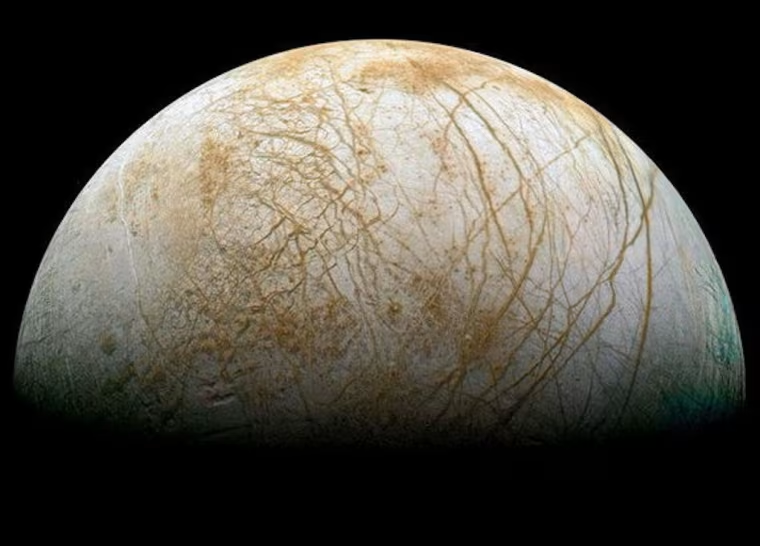
One Massachusetts-sized chunk of ice disappeared completely. Kattenhorn and Prokter think the phenomenon of one geological plate sliding under another, which is known as subduction, is the most likely explanation for the disappearing puzzle piece. They cite several lines of supporting evidence, including potential "cryolavas" of water ice near the plate boundary.
If the scientists' interpretation — laid out in a study published online Sunday in the journal Nature Geoscience— is correct, planetary science textbooks will have to be rewritten.
— Mike Wall, Space.com
















This is a condensed version of a report from Space.com. Read the full report. Follow Mike Wall on Twitter and Google+. Follow Space.com on Twitter, Facebook and Google+.