NASA on Thursday announced the discovery of Kepler-452b, the most Earth-like planet ever found. Located 1,400 light-years from our planet, NASA called it "Earth 2.0," because it's the first small, rocky planet discovered in the habitable zone of a G star similar to our sun.
“We can think of Kepler-452b as an older, bigger cousin to Earth, providing an opportunity to understand and reflect upon Earth’s evolving environment," said Jon Jenkins, the Kepler data analysis lead at NASA's Ames Research Center.
The planet is 5 percent farther away from its star than Earth is to the sun, making for a slightly longer year of 385 days, but gets similar light because its sun is 20 percent brighter than our own.
"The sunshine from this star would feel very similar to the sunshine from our star," Jenkins told reporters.
NASA believes the planet has a mass about five times more massive than Earth's, with a rocky surface below a thicker atmosphere than our own. Gravity would be about twice as strong on Kepler-452b as it is on Earth, NASA said.
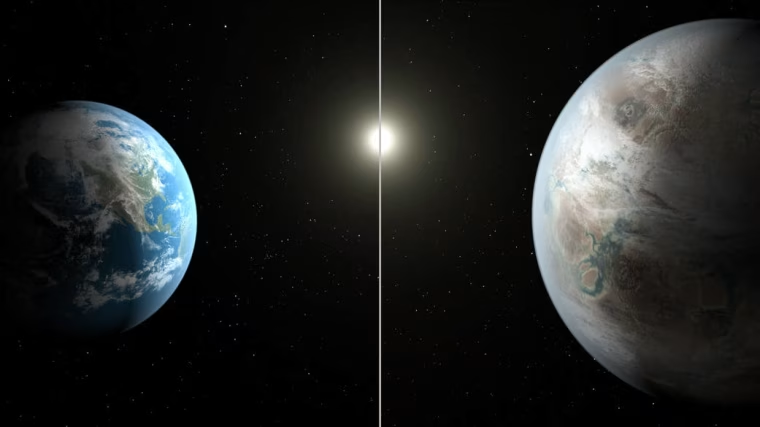
The planet is located in the Kepler-452 system in the constellation Cygnus. Its sun has the same surface temperature as our own, but has a diameter that is 10 percent larger.
In addition to Kepler-452b, the $600 million Kepler Space Telescope, which launched in 2009, discovered 11 other less notable new planets. The Kepler mission searches for Earth-like planets by looking for a dip in the brightness of stars, which indicates a planet is passing between the star and the telescope.







 FOR SUBSCRIBERSA harrowing ordeal aboard an Israel-bound plane







FOR SUBSCRIBERSThe debate over AI’s future rages on both coasts

FOR SUBSCRIBERSA harrowing ordeal aboard an Israel-bound plane
FOR SUBSCRIBERSThe debate over AI’s future rages on both coasts
Related:Earthlike Worlds Boost Kepler Probe's Exoplanet Tally Past 1,000
The space telescope's main goal is to find so-called "Goldilocks planets" in the habitable zone of stars — worlds where it's not too cold or hot for liquid water to form. With the discovery of Kepler-452b, the Kepler telescope has now discovered 1,030 confirmed planets.
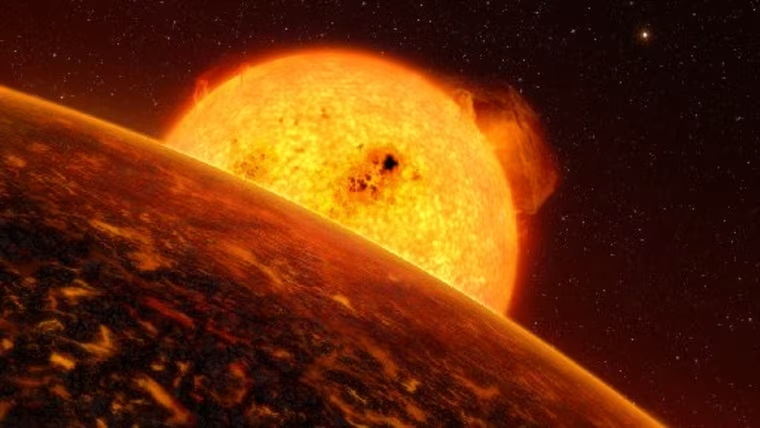
The next step is to use the James Webb Telescope to do a spectroscopic analysis of the Earth-like planet to gain a better understanding of its atmosphere.
While NASA scientists have no idea if Kepler-452b's atmosphere is conducive to life, they do know that there has been plenty of time for organisms to develop.
"It's awe-inspiring to consider this planet spent 6 billion years in the habitable zone of its star, which is longer the age of the Earth," Jenkins said. "That is considerable time and opportunity for life to arise somewhere on it surface or oceans if all the necessary conditions for life exist on this planet."
