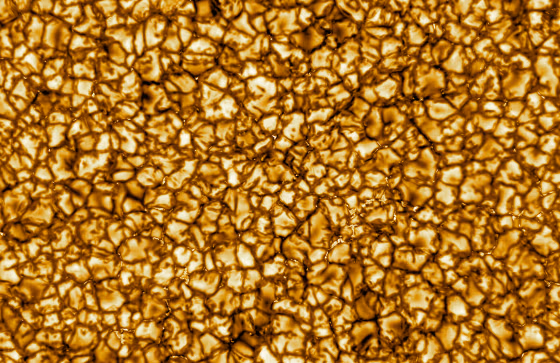
Images from a powerful new telescope installed on top of a volcano in Hawaii show the surface of the sun in the closest detail yet, revealing features as small as 30km (18 miles) across.
They were captured by the National Science Foundation’s (NSF) Daniel K. Inouye Solar Telescope, which sits at around 10,000 feet (3,000 metres) above sea level near the summit of Haleakala volcano in Maui, Hawaii.
The telescope, which features the world’s largest solar 4-meter (13 feet) mirror, could enable a greater understanding of the sun and its impact on our planet, according to the National Solar Observatory, a public research institute headquartered in Boulder, Colorado.







 FOR SUBSCRIBERSA harrowing ordeal aboard an Israel-bound plane







FOR SUBSCRIBERSThe debate over AI’s future rages on both coasts

A pattern of turbulent, “boiling” gas is shown covering the sun, which is some 93 million miles from Earth.
Inside visible cell-like structures, each around the size of the U.S. state of Texas, hot plasma can be seen rising before cooling off and sinking below the surface in dark lanes, as part of a process called convection.
FOR SUBSCRIBERSA harrowing ordeal aboard an Israel-bound plane
FOR SUBSCRIBERSThe debate over AI’s future rages on both coasts
Markers of magnetic fields are also visible with new clarity, the NSO said.
Studying the sun’s activity, or “space weather”, can help scientists predict problems on Earth. Magnetic eruptions on the sun can disrupt satellites, disable GPS, impact air travel, bring down power grids and cause blackouts.
“This telescope will improve our understanding of what drives space weather and ultimately help forecasters better predict solar storms,” said France Córdova, NSF director.
