Saturn's moon Enceladus is home to a global ocean hidden under its icy exterior, according to a new study.
Previous research indicated a sea hidden below the south pole, but now scientists believe the body of water extends across the entire moon.
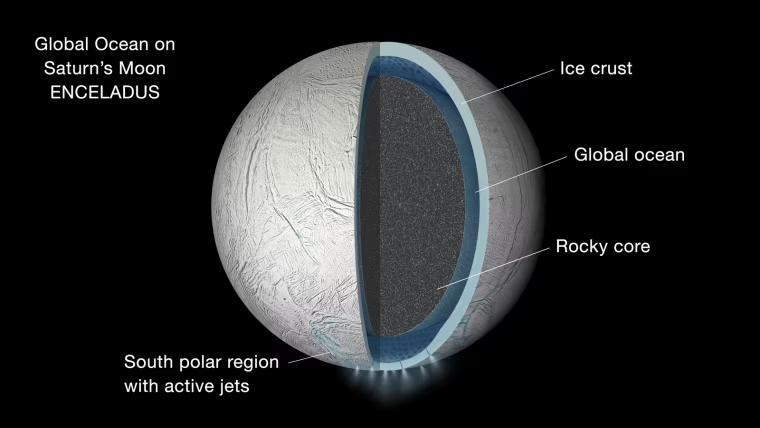
Using data gathered by NASA's Casini spacecraft, researchers noticed that Enceladus wobbled in a certain way as it orbited Saturn. That wobble indicated that the moon's icy crust didn't extend all the way to its core — instead, it rested on a global ocean, the researchers concluded.







 FOR SUBSCRIBERSA harrowing ordeal aboard an Israel-bound plane







FOR SUBSCRIBERSThe debate over AI’s future rages on both coasts

FOR SUBSCRIBERSA harrowing ordeal aboard an Israel-bound plane
FOR SUBSCRIBERSThe debate over AI’s future rages on both coasts
Their work was published this week in the journal Icarus.
"This was a hard problem that required years of observations, and calculations involving a diverse collection of disciplines, but we are confident we finally got it right," Peter Thomas, lead author of the study and a Cassini imaging team member at Cornell University, said in a statement.

Earlier this year, several studies suggested that Enceladus has active underwater hydrothermal vents near its south pole, which could theoretically heat the water enough to sustain life.
