A Mars-size planet about 200 light-years from our solar system has turned out to be the lightest known alien world orbiting a normal star, researchers say.
Astronomers made the discovery after measuring the size and mass of the baking-hot planet, named Kepler-138 b. The planet orbits a red dwarf star called Kepler-138, which is located about 200 light-years from Earth in the constellation Lyra and has a mass about half that of the sun.
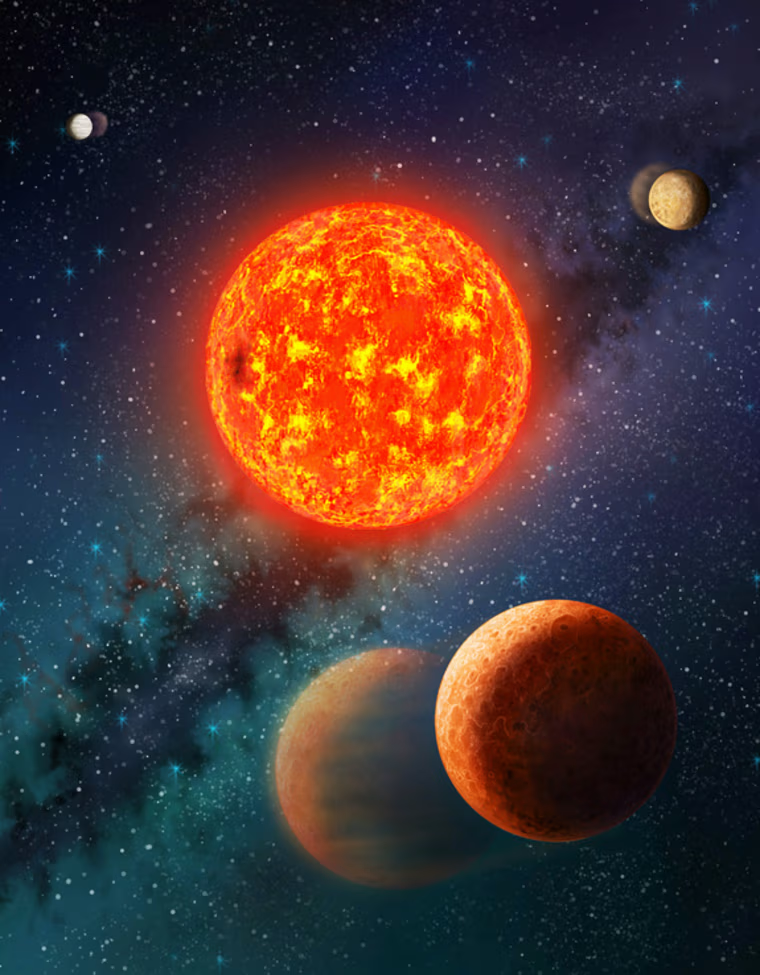
Kepler-138 is home to three exoplanets. Two of them — Kepler-138 c and Kepler-138 d — are each about 1.2 times as wide as Earth. But the third, Kepler-138 b, is just a little more than half as wide as Earth, making it about the size of Mars. "Kepler-138 b has the same apparent size to us as a golf ball 10 million kilometers [6.2 million miles] away," said Daniel Jontof-Hutter, an astronomer at Penn State University.







 FOR SUBSCRIBERSA harrowing ordeal aboard an Israel-bound plane







FOR SUBSCRIBERSThe debate over AI’s future rages on both coasts

FOR SUBSCRIBERSA harrowing ordeal aboard an Israel-bound plane
FOR SUBSCRIBERSThe debate over AI’s future rages on both coasts
The three exoplanets orbit very close to their star. Kepler-138 b takes a little more than 10 days to complete its orbit, Kepler-138 c requires nearly 14 days, and Kepler-138 d needs about 23 days.
Using NASA's Kepler spacecraft, the researchers looked at how the gravitational tug-of-war among these exoplanets influenced the lengths of their orbits. Because the strength of a planet's gravitational pull is directly related to its mass, the scientists were able to weigh all three of these planets.
The astronomers found that the mass of the Mars-size inner planet, Kepler-138 b, is only 6.7 percent of Earth's. That makes it about two-thirds the mass of Mars.
"Kepler-138 b is the first exoplanet smaller than Earth to have both its size and its mass measured," Jontof-Hutter said.
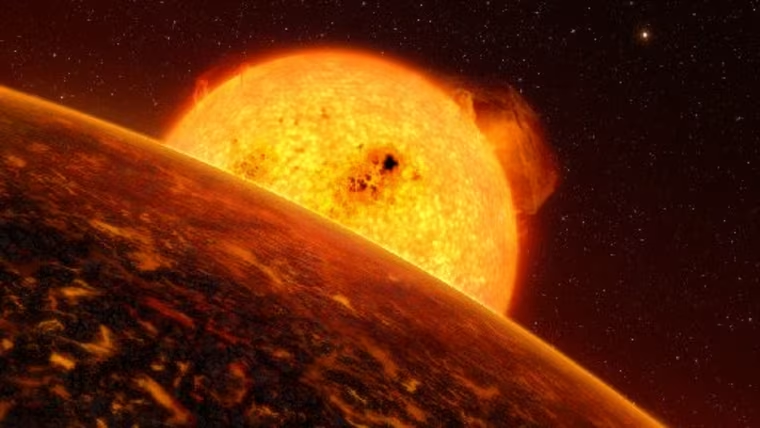
The least massive known alien world may be the exoplanet PSR B1257+12 b, which is thought to have only 2 percent of Earth's mass. That world does not orbit a normal star, but instead circles a pulsar — the dense, rapidly spinning remnant of a supernova explosion.
Knowing the mass and width of Kepler-138 b helped the researchers calculate its density. They determined the density to be about two-thirds that of Mars, which suggests the alien planet has a purely rocky composition.
Jontof-Hutter and his colleagues detailed their findings in Thursday's issue of the journal Nature.
This is a condensed version of a report from Space.com. Read the full report. Follow Space.com on Twitter, Facebook and Google+.