Earth's powerful gravity tugged the moon into its oddball shape long ago, shortly after both bodies formed, a new study suggests.
Tidal forces exerted during the early days of the solar system can explain most of the moon's large-scale topography, including its slight lemon shape, reports the study, which was published online today (July 30) in the journal Nature.
"What is the origin of that asymmetry?" said study lead author Ian Garrick-Bethell, of the University of California, Santa Cruz. "Chipping away at this problem of the shape of the moon can give us insight into those types of fundamental geology problems," he told Space.com.
Scientists think the moon formed from debris blasted into space when a mysterious planet-size body slammed into the young Earth about 4.5 billion years ago. The moon was born hot, and it came into existence quite close to our home planet. (The moon has been slowly spiraling away ever since.)
The newborn moon was thus primed to be sculpted by Earth's gravity, and that's exactly what happened, researchers say.
Indeed, scientists have posited for more than a century that tidal forces helped shape the molten moon, causing bulges that froze into place when Earth's natural satellite cooled down and solidified. But the new study provides a much more detailed understanding of how this likely happened.Garrick-Bethell and his team studied topographic data gathered by NASA's Lunar Reconnaissance Orbiter and information about the moon's gravity field collected by the agency's twin GRAIL (Gravity Recovery and Interior Laboratory) spacecraft.
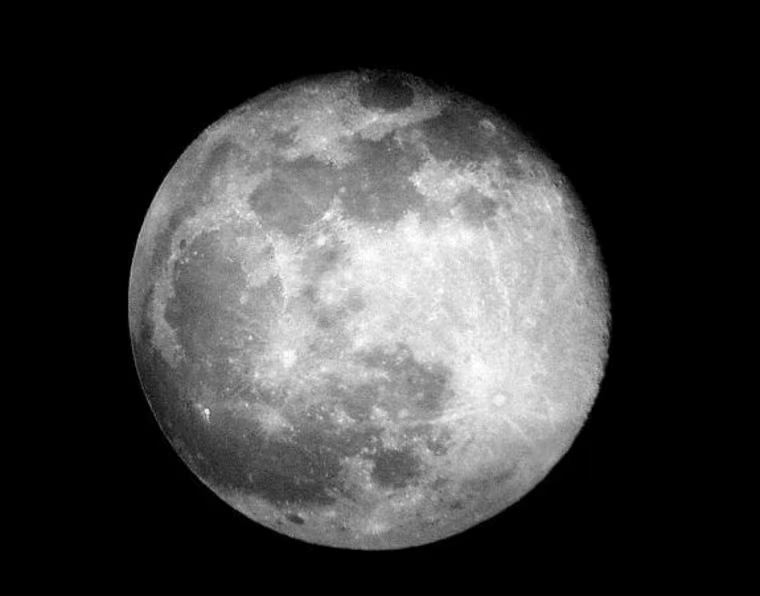
The data strongly implicate tidal effects as a key shaper of the moon, researchers said. For example, tidal forces pulled on the lunar crust, stretching it out and heating it up in places. This process thinned out the crust at the lunar poles and thickened it in the regions that lined up with Earth, helping sculpt the moon into a lemon with two small bulges (one on the side facing our planet, and one on the side directly opposite).
Such tidal heating could have occurred only when the moon's crust was floating on a sea of molten rock, largely decoupled from the rest of the body, Garrick-Bethell said."This happened a long time ago, when the moon was not completely solid," he said. "This was in the first 100 to 200 million years of lunar thermal evolution."







 FOR SUBSCRIBERSA harrowing ordeal aboard an Israel-bound plane







FOR SUBSCRIBERSThe debate over AI’s future rages on both coasts

FOR SUBSCRIBERSA harrowing ordeal aboard an Israel-bound plane
FOR SUBSCRIBERSThe debate over AI’s future rages on both coasts
-- Mike Wall, Live Science
This is a condensed version of an article that appeared on Live Science. Read the entire story here. Follow Mike Wall on Twitter @michaeldwall and Google+. Follow us @Spacedotcom, Facebook or Google+.
- How the Moon Was Made: Lunar Evolution Explained (Infographic)
- The Moon: 10 Surprising Lunar Facts
- Moon Master: An Easy Quiz for Lunatics
Copyright 2014 SPACE.com, a TechMediaNetwork company. All rights reserved. This material may not be published, broadcast, rewritten or redistributed.