Lobsters may appear bright red when they arrive at your dinner table, but they didn't start out that way. Scientists at the University of Manchester think they have the definitive explanation for why the tasty crustaceans change color when cooked.
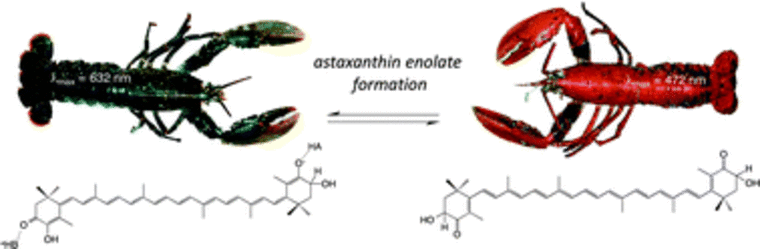
It's long been known that the color change has to do with a chemical in the shell called astaxanthin, which in its free state has a bright orange-red hue. When astaxanthin binds with a complex of proteins in the shell called crustacyanin, the reaction give the lobsters their natural dark blue, brown or gray color.
Put a lobster in a pot of scalding water, however, and the crustacyanin denatures; astaxanthin is released and reverts to its orange-red state. A team led by University of Manchester chemistry professor John Helliwell said it has determined the chemical mechanism underlying the color shift.
The researchers found that astaxanthin can behave as an acid, which is crucial when it binds with the crustacyanin proteins.
Helliwell said the binding and unbinding properties of the chemicals could have useful applications in the health and food industries.
"For example astaxanthin is an antioxidant, so it has many health properties. But because it is insoluble in water the problem is how to deliver it to a target. But our findings suggest that mixing it with crustacyanin could do that and allow the astaxanthin to get to a target such as via the stomach," Helliwell said in a statement.







 FOR SUBSCRIBERSA harrowing ordeal aboard an Israel-bound plane







FOR SUBSCRIBERSThe debate over AI’s future rages on both coasts

FOR SUBSCRIBERSA harrowing ordeal aboard an Israel-bound plane
FOR SUBSCRIBERSThe debate over AI’s future rages on both coasts
"It could also be used as food dye, for example to help create blue-colored ice cream. Or it could be used in food stuffs to help people know when food has been cooked properly; a dot on the food that changes color when it reaches a certain temperature could be used."
The research is published in the journal Physical Chemistry Chemical Physics.