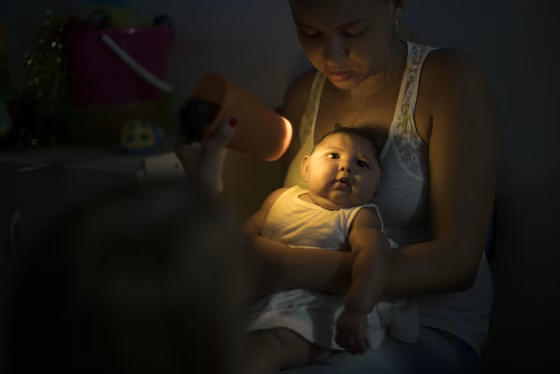
As many as 1.65 million women in Latin America could be infected with Zika while pregnant, meaning tens of thousands of pregnancies could be at risk, researchers said Monday.
It's the first real estimate of just how many actual pregnancies are at real risk, based on birth rates in each country and other factors.
Brazil's likely to be the worst affected, the team at the University of Notre Dame and Britain's University of Southampton found.

The team calculated the subset of women who get pregnant every year and who go on to have a baby -- many pregnancies end in miscarriage.
Their best estimate is between 1.5 million and 2 million women will get infected while pregnant during the first wave of the Zika epidemic if it lasts two to three years. They settled on 1.65 million as the most likely number.
Related: Any Kind of Sex Can Spread Zika







 FOR SUBSCRIBERSA harrowing ordeal aboard an Israel-bound plane







FOR SUBSCRIBERSThe debate over AI’s future rages on both coasts

FOR SUBSCRIBERSA harrowing ordeal aboard an Israel-bound plane
FOR SUBSCRIBERSThe debate over AI’s future rages on both coasts
"The central concept behind our approach is that of the ‘first-wave’ epidemic. Zika and other mosquito-borne viruses have been known to exhibit explosive outbreaks, infecting as much as 75 percent of a population in a single year," the team wrote in their report, published in the journal Nature Microbiology.
"We think these projections may be pretty good for a location where Zika shows up and starts an epidemic, but at the same time we acknowledge that due simply to random chance and the fact that some places are relatively isolated and sparsely populated, the virus won’t make it to every single corner of the continent,” Notre Dame's Alex Perkins said in a statement.
Zika's known to cause a range of birth defects, from brain damage that leads to an unusually small head, called microcephaly, to more subtle nerve, organ and limb defects.
