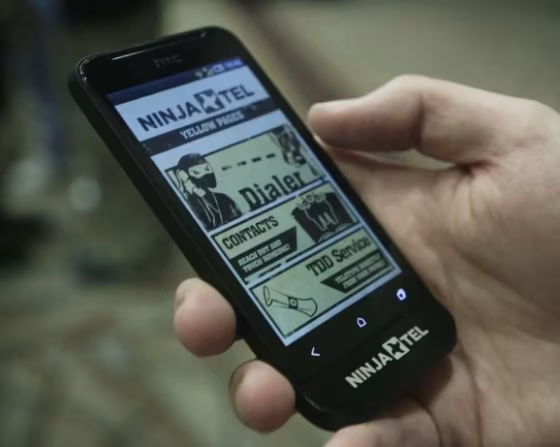
The Defcon hacker conference in Las Vegas had an official mobile carrier this year, but it wasn't AT&T or Verizon; they made their own, called Ninja Tel, complete with phones, a custom OS and apps, and an independent cellular network. It's one of the most high-profile examples so far of this kind of "pop-up carrier," and the whole system is compact enough to fit into a van.
Ninja Networks, a well-known crew of hackers and developers, put the network together mainly "to do something cool," as one of the organizers put it to Ars Technica. And the fact that every network at this gathering of hackers is probably being probed and monitored by multiple parties gives the experiment a practical edge.
Essentially what they did to create Ninja Tel was set up a single-antenna system that has all the necessary items and software to be a fully functioning GSM cellular network, jammed inside a big van. They gave out phones to select attendees: HTC One Vs with special SIM cards and a custom "Ninja OS" running on top of Android.







 FOR SUBSCRIBERSA harrowing ordeal aboard an Israel-bound plane







FOR SUBSCRIBERSThe debate over AI’s future rages on both coasts

Users of these Ninja Tel phones were only able to contact each other, but apps on the phone let people buy swag at special vending machines and use a text-based communication tool, and the device itself got you in the the Ninja VIP party.
Six hundred and fifty new smartphones and a van packed with telecommunications equipment don't come for free, though, and Ninja Networks had a little help raising presumably several hundred thousand dollars to pull off the feat. And some hackers must have balked at using the system because of its sponsors: Facebook and Zynga, not exactly the favorite companies of security experts who value independence and anonymity.
FOR SUBSCRIBERSA harrowing ordeal aboard an Israel-bound plane
FOR SUBSCRIBERSThe debate over AI’s future rages on both coasts
The network only lasted as long as the conference, or at least, that's when the van holding the network was likely driven away. But those lucky enough to score the phones will be able to use them with a working SIM, once they reinstall the original Android OS.
Devin Coldewey is a contributing writer for NBC News Digital. His personal website is coldewey.cc.