The first manned flight of NASA's Orion spacecraft, which is being built to help humanity explore Mars and other distant destinations, may be delayed by two years, until 2023, agency officials announced Wednesday.
Orion's first crewed sojourn, known as Exploration Mission 2 (EM-2), is officially targeted for launch in August 2021. But after conducting a thorough review of the Orion program last month, NASA is now acknowledging the possibility of a delay for EM-2, saying the liftoff will occur "no later than April 2023."
Engineers and technicians are still working toward the August 2021 goal, but hitting that target is unlikely, said NASA Associate Administrator Robert Lightfoot. [The Orion Capsule: NASA's Next Spaceship (Photos)]
"It's not a very high confidence level, I'll tell you that, because of the history — the things we see historically pop up," Lightfoot told reporters during a teleconference Wednesday (Sept. 16). Such factors include complications arising from the reuse of equipment from flight to flight and software development, he added.
"We're not seeing any issues in those areas, but we have to account for those, because we have a lot of runway in front of us," Lightfoot said.
Related: NASA Chief to Congress: 'Don't Make Us Hitch Rides With Russia'







 FOR SUBSCRIBERSA harrowing ordeal aboard an Israel-bound plane







FOR SUBSCRIBERSThe debate over AI’s future rages on both coasts

FOR SUBSCRIBERSA harrowing ordeal aboard an Israel-bound plane
FOR SUBSCRIBERSThe debate over AI’s future rages on both coasts
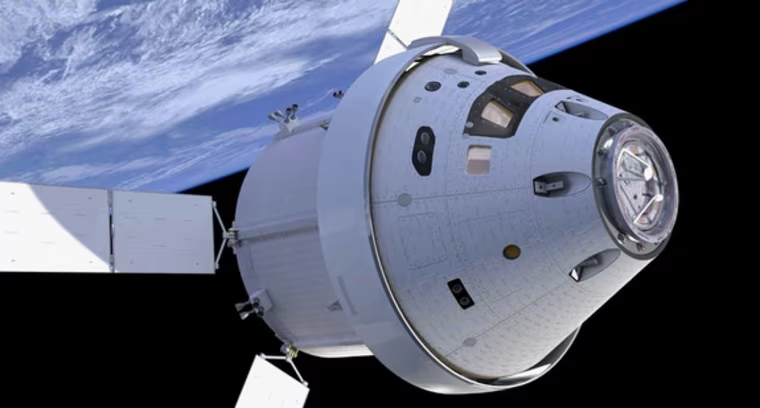
NASA is developing Orion, which can support a crew of four for up to 21 days, as well as a megarocket called the Space Launch System (SLS) to enable the crewed exploration of deep space. The capsule will get astronauts to space and back to Earth, and it will carry them on missions in Earth-moon space. (Long journeys, such as the trek to Mars, will feature habitat modules for crewmembers to live in.)
"Orion is a predominant, first key player in really allowing us to move human presence out of low Earth orbit," said Bill Gerstenmaier, associate administrator for NASA's Human Exploration and Operations Directorate.
Orion blasted off for the first time last December, riding a United Launch Alliance Delta IV Heavy rocket on a successful unmanned mission called Exploration Flight Test 1 (EFT-1). SLS won't reach space until 2018, when it sends an uncrewed Orion winging around the moon on the weeklong Exploration Mission 1 (EM-1).
EM-2's destination and duration aren't finalized yet, but Orion will carry astronauts on the mission.
This is a condensed version of a report from Space.com. Read the full report. Follow Mike Wall on Twitter @michaeldwall and Google+. Follow Space.com @Spacedotcom, Facebook or Google+.