
 FOR SUBSCRIBERSCBP leaders cut out of Trump ad buy decision









FOR SUBSCRIBERSA harrowing ordeal aboard an Israel-bound plane





FOR SUBSCRIBERSCBP leaders cut out of Trump ad buy decision
FOR SUBSCRIBERSA harrowing ordeal aboard an Israel-bound plane
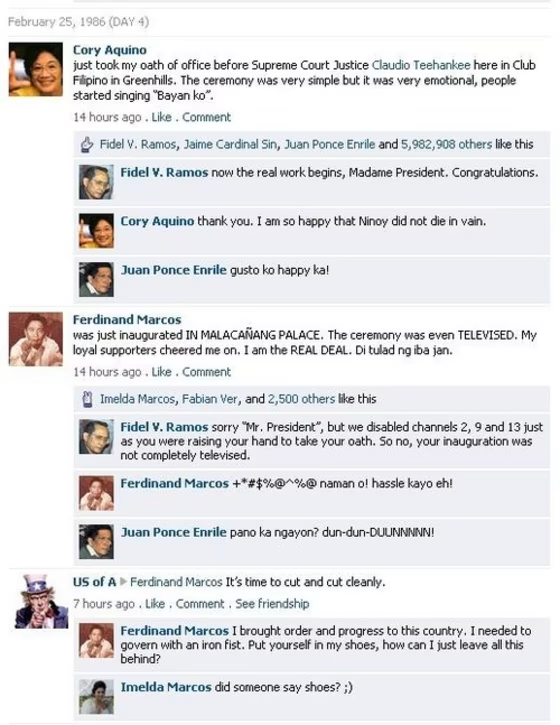
For a generation born after (or shortly before) the 1986 EDSA People Power revolution in the Philippines, they only know what happened through history books and stories from their elders. But now, they can scroll through those events through a Facebook reenactment, complete with status updates and comments from the fictionalized versions of Cory Aquino, Ferdinand Marcos and the "US of A."
This version may be a good way to introduce them to the major cast of characters, the events leading up to the revolt and to see how a pre-social media world toppled a dictator. We've already seen how the Nativity story has been re-imagined through social networks and Google products, so today's kids should be well tuned and open to this technique.
GMA News drew from their creative well to give us a rousing rendition of a revolution in progress, stating from the get-go: "The events and players are true, the status updates are based on fact, and the comments are totally imagined."
It uses Tagalog, "Taglish" (a combination of the Filipino dialect and English), the modern English vernacular, acronyms (LOL!) and FB slang to bring the revolution home. Shades of the recent uprising in Egypt are definitely sewn in throughout the narrative, but there is probably much more to laugh about 24 years from an event than from something so fresh as the anti-Mubarak movement.
It starts with the August 31, 1983 funeral of Benigno S. Aquino, Jr., affectionately known as "Ninoy." A popular opposition leader against longtime president Ferdinand Marcos, he had been assassinated 10 days earlier, upon a return to the Philippines after living in exile in the U.S. In this version of events, his widow, Cory Aquino, creates a Facebook event for the funeral, and invites everyone. More than 1.2 million attend.
About two years later, the next post comes from Ferdinand Marcos, whose status update reads: "Still at the top, baby. Still in control. Martial law rocks!"
But about a month after that, in December 1985, Cory Aquino decides to run for president. To which Ferdinand Marcos comments: "ROFLMAO! This is an even bigger joke than Salvador Laurel running for President." Laurel then comments under that: "I’m going to be Mrs. Aquino’s running mate, Mr. President."
While Marcos gets the last word in that thread ("Whatevs. See you on election day."), the posts and comments reveal the unraveling of the regime by late February 1986, as People Power built up strength. Readers will find out about EDSA, which stands for Epifanio Delos Santos Avenue in Metro Manila, the main thoroughfare where the mass protests happened. EDSA I is another name for the the first People Power revolution that ousted Marcos. (EDSA II was the second people power revolution that up-ended Joseph Estrada from the presidency.)
Before long, Marcos is being unfriended left and right, leaving even Uncle Sam to post on Marcos' wall: "It’s time to cut and cut cleanly."
Marcos replies: "I brought order and progress to this country. I needed to govern with an iron fist. Put yourself in my shoes, how can I just leave all this behind?"
And then the last appearance of Imelda: "did someone say shoes? ;)" Those too young to remember: Imelda Marcos had a lot of shoes. Maybe not by Carrie Bradshaw standards, but Imelda set the bar for her day.
You know who else sets the bar? Filipinos who use Facebook, whose users number over 600 million around the world. The Next Web pointed out that, according to Facebook statistics trackers Socialbakers, the Philippines accounts for 22 million Facebook users, and ranks fifth in top Facebook countries (by user count), behind Turkey, the UK, Indonesia and the U.S. (in first place).
This is a different ranking than those recently released by Facebook, that placed the UK, France and Italy behind the still No.1 U.S., with Canada and Germany tying for fifth place. Turkey, Indonesia and the Philippines don't even show up on that Western-centric slide.
GMA News used, as its references: "Chronology of a Revolution" by Angela Stuart Santiago, "People Power: An Eyewitness History," edited by Monina Allarey Mercado, "Kasaysayan: The Story of the Filipino People. A Timeline of Philippine History" and Philippine Daily Inquirer archives.
More stories about revolt and technology:
- Bahrain Internet service starting to slow
- Facebook looks to downplay role in Egyptian revolution
- How the Internet brought down a dictator
Check out Technolog on Facebook, and on Twitter, follow Athima Chansanchai, who is often mistaken for a Filipina.