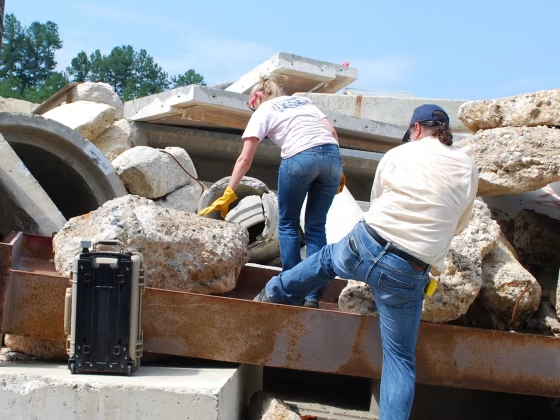
When buildings crumble after an earthquake or tornado, first responders have a few precious hours to locate people trapped under concrete slabs and bricks. A new device that detects a human heartbeat under 30 feet of rubble could help rescue workers get to trapped survivors even if they're unconscious and can't call for help.
"To my knowledge no one has delivered an actual product that is usable by first responders that detects heartbeat," Jim Lux, a task manager on the "Finding Individuals for Disaster and Emergency Response" project, developed at NASA's Jet Propulsion Labs, told NBC News.
The device uses an age-old physics principle: microwaves are beamed on a pile of rubble, which is like "shining a light" into a thick fog. The microwaves bounce back, but reflect tiny movements, even the 1-millimeter shift of the body caused by a pulse.
Rescue teams currently use trained sniffer dogs, and an arsenal of devices that include machines to track breathing or body heat. They also listen for people calling out or tapping for help. "But if someone is unconscious and unresponsive, [a] heartbeat's the only thing you've got," Lux said.
Compared to devices that detect body movements due to breathing, the heartbeat sensor is more sensitive and can detect movements that are deeper in rubble.
This week, firefighters of Virginia Task Force 1 in Lorton, Va., are testing a prototype device independently, following a year of development at JPL. The device has a 14-hour battery life, enough to last shifts that are usually 12 hours long. It weighs 20 pounds and can "fit in the overhead compartment of an airplane," Lux said.

 FOR SUBSCRIBERSCBP leaders cut out of Trump ad buy decision









FOR SUBSCRIBERSA harrowing ordeal aboard an Israel-bound plane





The crew will put the device through a round of tests and suggest improvements for Lux's team. The plan is to include fixes via a software update.
FOR SUBSCRIBERSCBP leaders cut out of Trump ad buy decision
FOR SUBSCRIBERSA harrowing ordeal aboard an Israel-bound plane
JPL won't be manufacturing the devices, but Lux says the device was designed to cost under $10,000 to make.
Nidhi Subbaraman writes about technology and science. You can follow her on Facebook, Twitter and Google+.