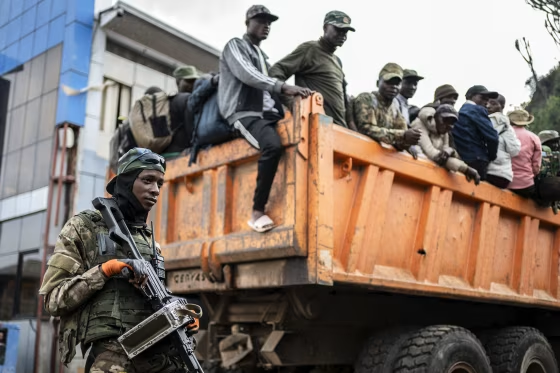
DAKAR, Senegal — Rwanda-backed rebels killed at least 140 people in farming communities in eastern Congo in July, Human Rights Watch said in a report Wednesday, describing the killings as “summary executions.”
The group said 141 people, predominantly ethnic Hutus, were feared dead or missing after the attacks near Virunga National Park in North Kivu province, citing local experts and witness accounts.
It said the killings appeared to be part of a military campaign by the M23 group, the most prominent of more than 100 armed groups in mineral-rich eastern Congo, against the Democratic Forces for the Liberation of Rwanda (FDLR), a mostly Hutu armed group.
Nearly 2 million Hutus from Rwanda fled to Congo after the 1994 Rwandan genocide that killed 800,000 Tutsi, moderate Hutus and others. Rwandan authorities have accused Hutus who fled of participating in the genocide, alleging that the Congolese army protected them.
The United States and others have been trying to achieve a permanent ceasefire since fighting between the M23 and Congolese forces escalated in January with the M23’s seizure of two key cities. U.S. President Donald Trump this week asserted he had “ended six wars” including this one, but experts say his impact isn’t as clear cut as he claims.
The U.N. has called the decades-old conflict in eastern Congo “one of the most protracted, complex, serious humanitarian crises on Earth.”
The Human Rights Watch report says the Rwanda Defense Force was involved in the M23 operations it describes, citing U.N. and military sources and witness accounts. There was no immediate comment from the Rwandan government.
“The M23 armed group, which has Rwandan government backing, attacked over a dozen villages and farming areas in July and committed dozens of summary executions of primarily Hutu civilians,” said Clementine de Montjoye, senior researcher at Human Rights Watch.
Witnesses said M23 soldiers, accompanied by Rwandan soldiers who were identified by their accents, told them to “immediately bury the bodies in the fields or leave them unburied, preventing families from organizing funerals,” the report said.
















One woman described being marched in a group to a riverbank near the town of Kafuru. The group of around 70 people was lined up before the soldiers began shooting at them. Forty-seven of the dead, including children, were identified, the report added.
Willy Ngoma, military spokesperson for M23, called the report “military propaganda.”
M23 was previously accused of extrajudicial killings during its seizure of major cities earlier this year.
A separate report by Amnesty International on Wednesday said the rights group found that both M23 and Congolese government-sponsored militias regularly committed mass atrocities and sexual violence against civilians, including gang rape.
“Rwanda and (Congo) cannot continue shunning responsibility; they must hold all perpetrators accountable,” said Tigere Chagutah, Amnesty International’s regional director for East and Southern Africa.
